Thoughts on Hubris and the inevitable march of time…

It has been a long time since I have posted on Old Man in a Boat Tour and much has happened in that interval.  Although I have continued to work on the Greta T , it has been sporadic, and it has been hard not to become demoralized over the slow pace of progress.  However, in September 2023, time and circumstances caught up with me … big time!

I sailed in a few Laser Masters’ regattas over the summer, but I had noticed that I was losing weight since the Spring – a lot of weight (over 30 pounds).  Then I started getting short of breath and somewhat unsteady on my feet.

The merde hit the proverbial fan when I collapsed at home on the 24th of September and was rushed to the local hospital – a syncope (fainting) – caused by a total heart block – i.e. one half of my heart wasn’t getting signals from the other half.  I was transferred to Hamilton General for an emergency pacemaker operation and upon returning to Emergency a few days later with severe headache, a very sharp ER doctor diagnosed an autoimmune condition called Giant Cell Arteritis.  This was unrelated to the heart issues and explained the weight loss, shortness of breath and unsteadiness of the previous months.  The pacemaker situation has fortunately stabilized after a two-month convalescence, but the autoimmune condition is going to take far longer to resolve and may be chronic.  Fortunately, I have avoided some of the nastier complications of this condition so far (stroke, blindness) and although I have to take a lot of pills every day and have regular headaches and dizziness  (gait ataxia- I walk like a drunken sailor) I am able to function after a fashion.  I was extremely fortunate to have landed at the Hamilton General where the expertise in this condition and the medical care was exceptional.

Which brings me to the issue of hubris – WOW… was I being cocky assuming age and health would not slow me down in my proposed trip for the Old Man in a Boat Tour!  In less than a week my plans came crashing rudely to earth.  Humble pie and egg on my face are other phrases that spring to mind!  Still, if the shoe fits…wear it!

So, here’s how I have picked myself up and dusted myself off – owing much to the tremendous care and loving help from my family – to re-imagine my fundraiser.

Realistically, I will not be able to complete the trip as planned and completing the Greta T is not on the cards for perhaps only somewhat late into 2024.  So, here’s the new plan:

  • Fit the oars to my canoe and start rowing along the southern shore of Lake Ontario from Grimsby Beach (conveniently 50 yards down the road from home).
  • Row 20 – 30 miles several times a week when the weather is reasonable.
  • Continue to work on Greta T
  • Repeat until I have completed the mileage of my original plans (somewhere around 1500 kms. )
  • If the boat gets finished before I am done the mileage, then I can finish the day trips by sailing as well as rowing!

I owe this new plan to the forward thinking of my daughter Maya who, along with my wife June, has pulled me through this crisis and given me renewed hope about salvaging some of my rather overly ambitious fundraising plans!

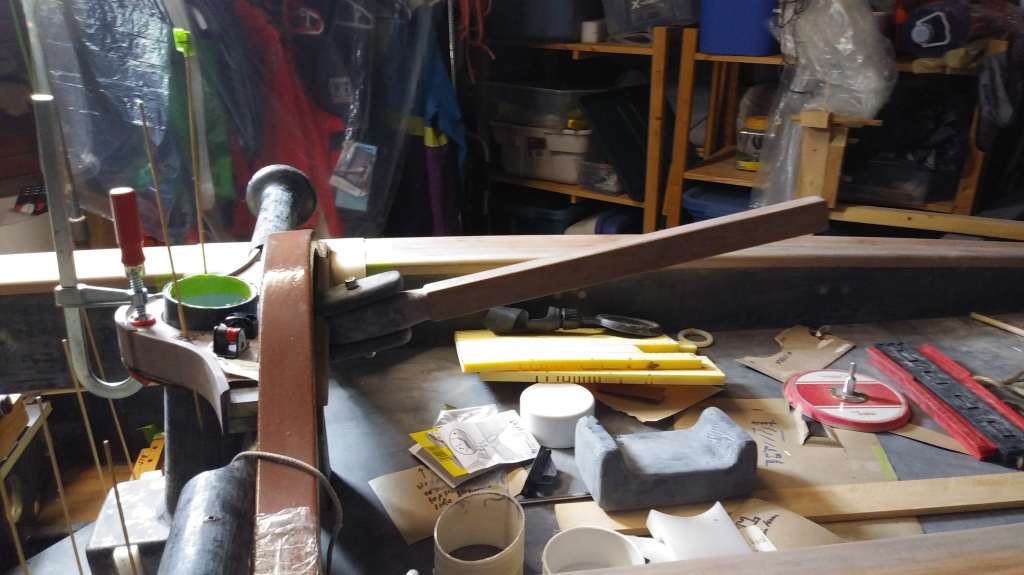
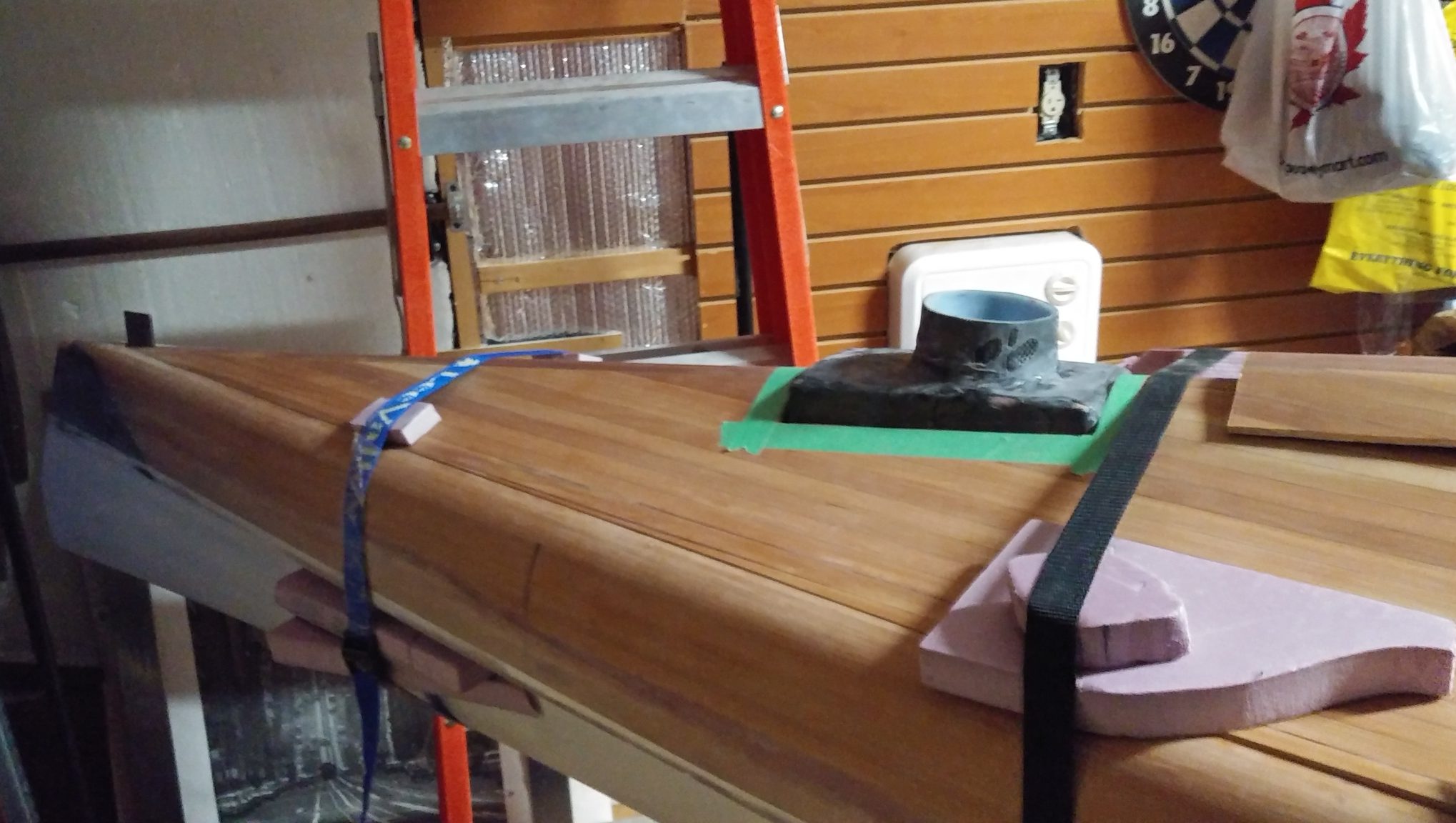
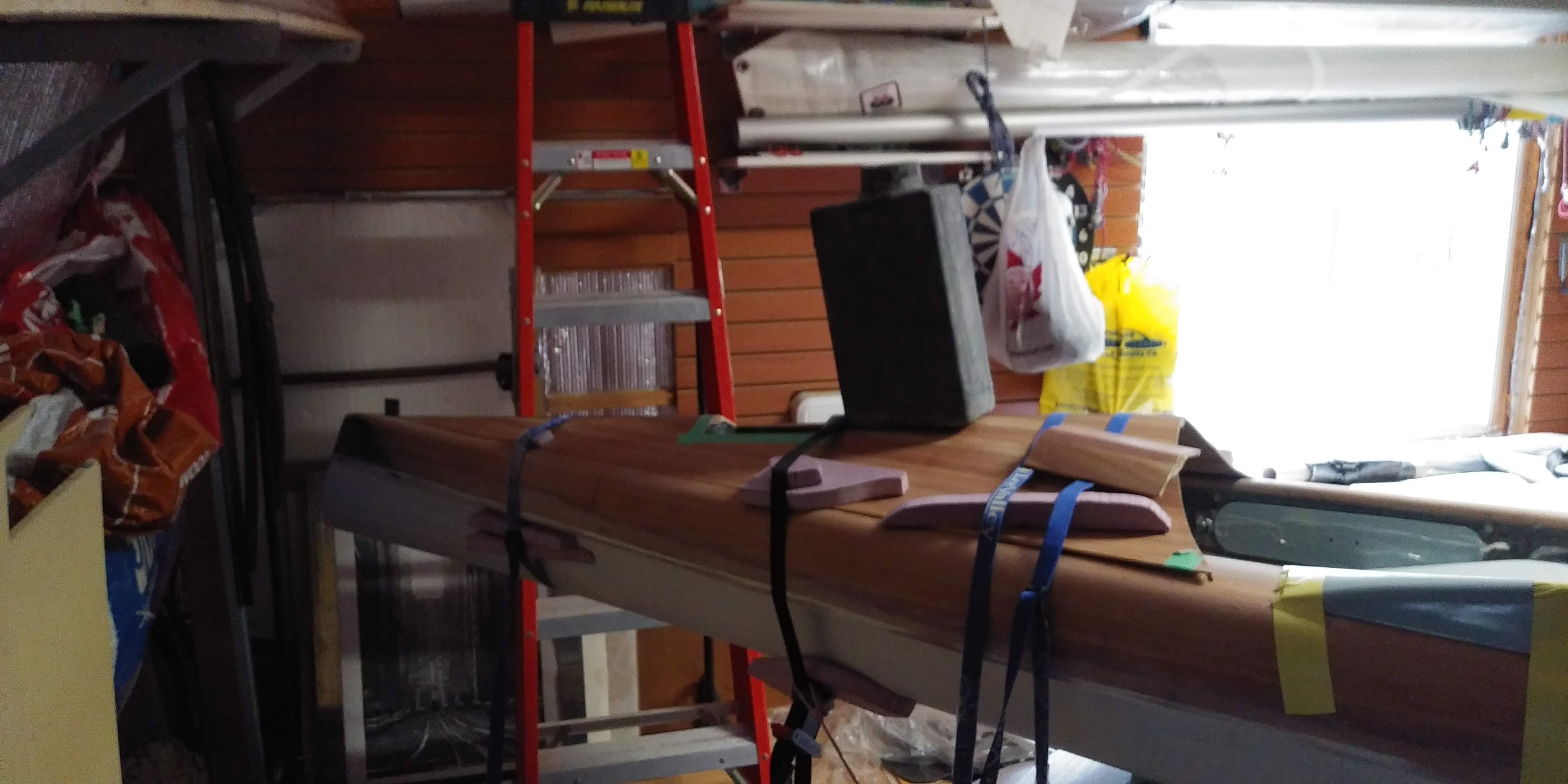
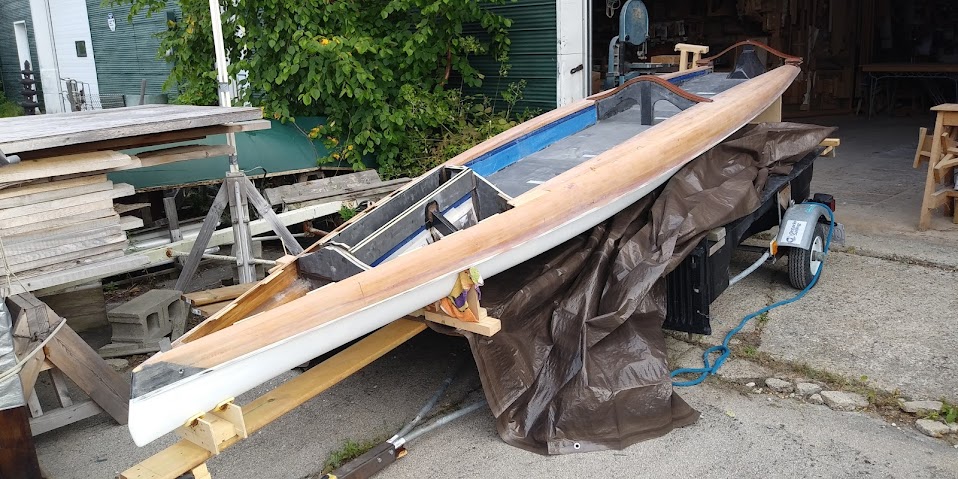
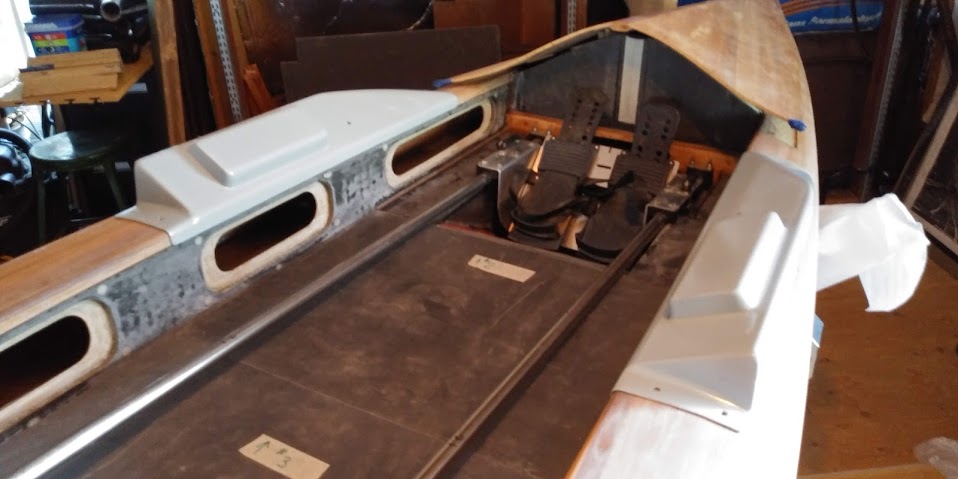
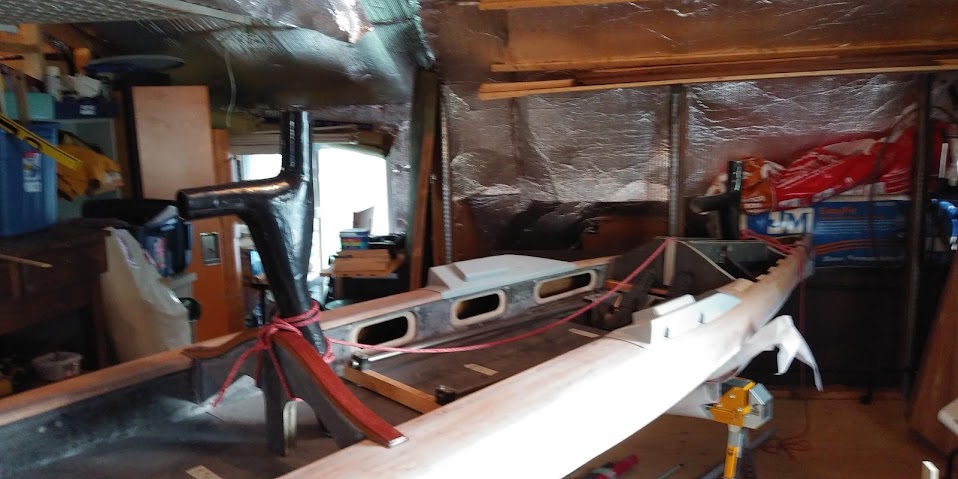
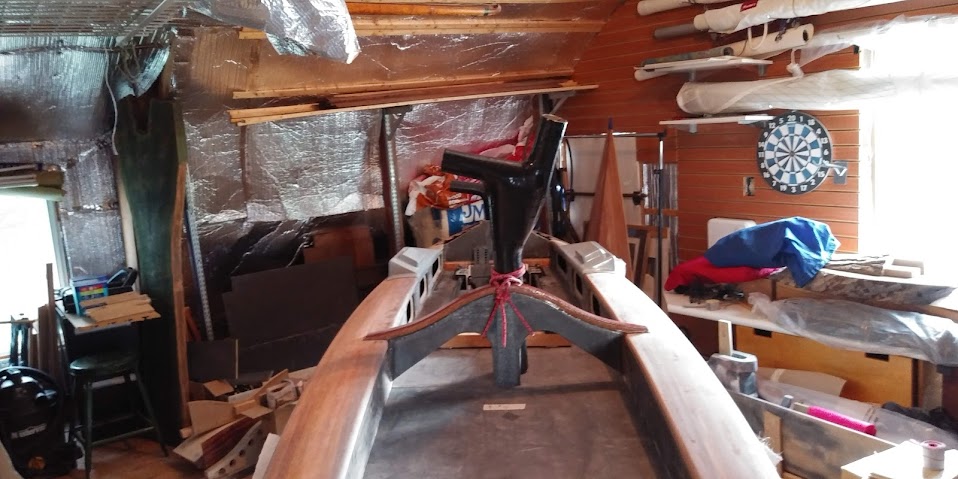
I have included some photos of the state of the latest progress on the Greta T  – the deck is almost ready to fasten in place and both mast steps are fabricated and fitted.  The leeboards are assembled, ready for carbon fibre laminating and installation and the sail controls and steering controls have been temporarily mocked up. 

However, much as I probably should be spending all my time (between resting) working on the boat, I have decided that I also need to have another priority, more in keeping with the state of my health and to keep my mental health in a positive state and also to repay my family for their tremendous support.

In a word, I have decided to begin Dostadning*  – The Gentle Art of Swedish Death Cleaning.

Now, before you think I am getting too morbid, let me explain what this is about.  It’s based on the simple philosophy that no one is immortal and that one of the greatest gifts you can give to your loved ones is that they don’t have to clean up all your messes when you die and are dealing (hopefully) with their own grief.  So, in short, start cleaning up, tidying, getting rid of all that stuff you are never going to use, NOW, in a systematic and timely way without getting too stressed about it and at a pace that is reasonable.  In my case, I hope my health situation resolves, but I think I can’t assume that, so Dostadning for me!

I have to say, that once I embarked on this (doing a bit each day, or at least 3 or 4 times a week) I have felt my spirits lift and been more energized than I had been for a long time!  The important thing is to maintain a sense of humour and humility all the while doing it. Here’s a portion of a blog post that I wrote last summer, but somehow never quite got around to publishing!


Of Collars and Collets and other details…  written June 22, 2022

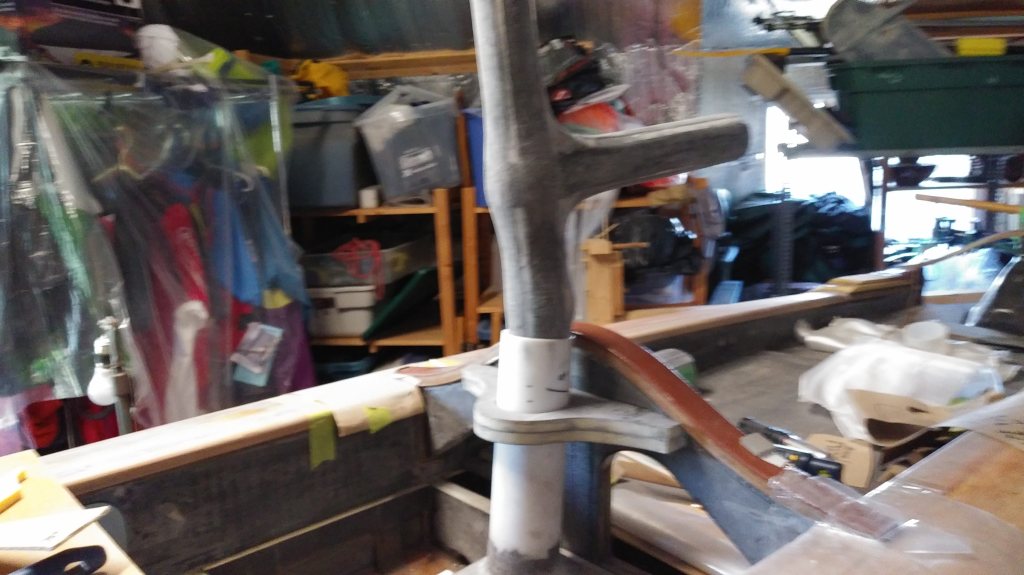
In the early days of building the Greta T  the problem of how to let the mast partners rotate easily was vaguely imagined as some form of plastic collars around the partners to rotate inside a larger tube/holder that was fixed in the deck.  In a stroke of serendipity, I managed to scrounge some quite sturdy white plastic 3” rigid plastic tubing that was at the side of the road outside a car window tinting shop in St. Catharines.  Apparently, the tubing is what the window tinting film comes wrapped around and although the tubes had been cut in half they were still long enough for my purposes.  Here’s a picture of the tubing (white) in use in the mast “cartridges” that will receive the mast partners.
A bit of research led me to a plastic called Acetal/Delrin, which has excellent machining and wear properties,  and is highly “slippery”, as the material of choice for the collars around  the mast partners that will rotate inside the larger tubes built into the mast cartridges.

My daughter, Maya, put her engineering and CAD drawing skills to good use and produced some drawing of the collars I would need.  Here’s a picture of one of them – the top section ( to be fitted just above deck level) which needs to cover the tube and allow a smooth rotation.
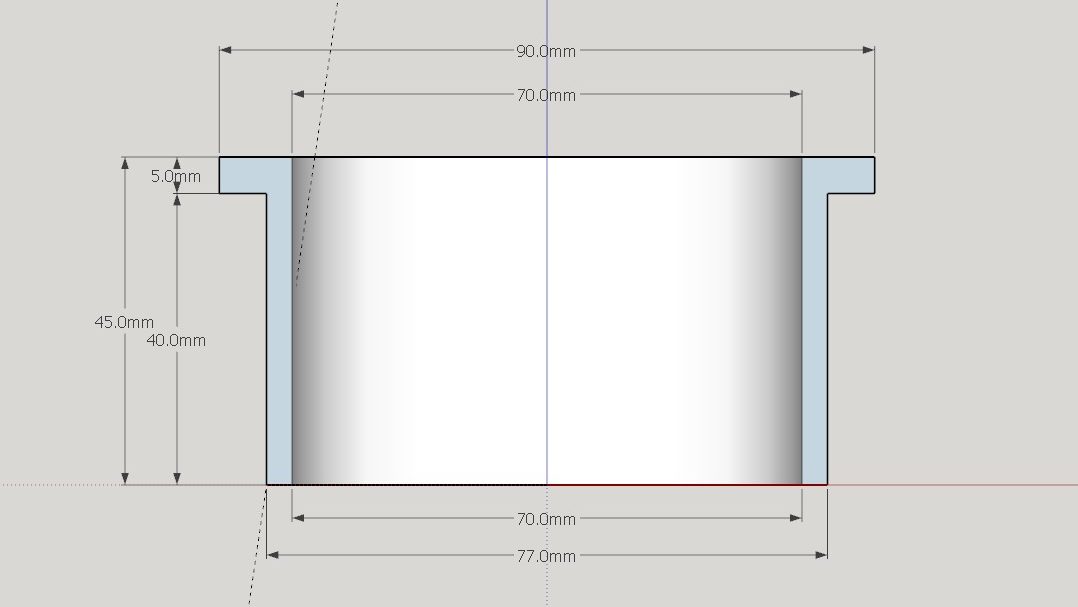
I thought I would turn them out on my lathe (a wood turning lathe) however, once I started on this, it become apparent that the Delrin is just too hard for a lathe chisel to cut cleanly – it chattered and cut unevenly producing a bumpy surface – not what one wants for smooth rotation!  A metal working lathe will have to be used.

So, I will have to get these collars (the others are similar, but without the flanges at the top) turned at a machine shop.  This has also proved to be a challenge as the two local shops I contacted seemed to be too busy to even respond to my e-mails… I guess I’ll have to drop by and collar them!  (P.S. – a very kind member of my sailing club, H.B.S.C., is a retired machinist and has kindly agreed to make these up for me – thanks Roy!!!)

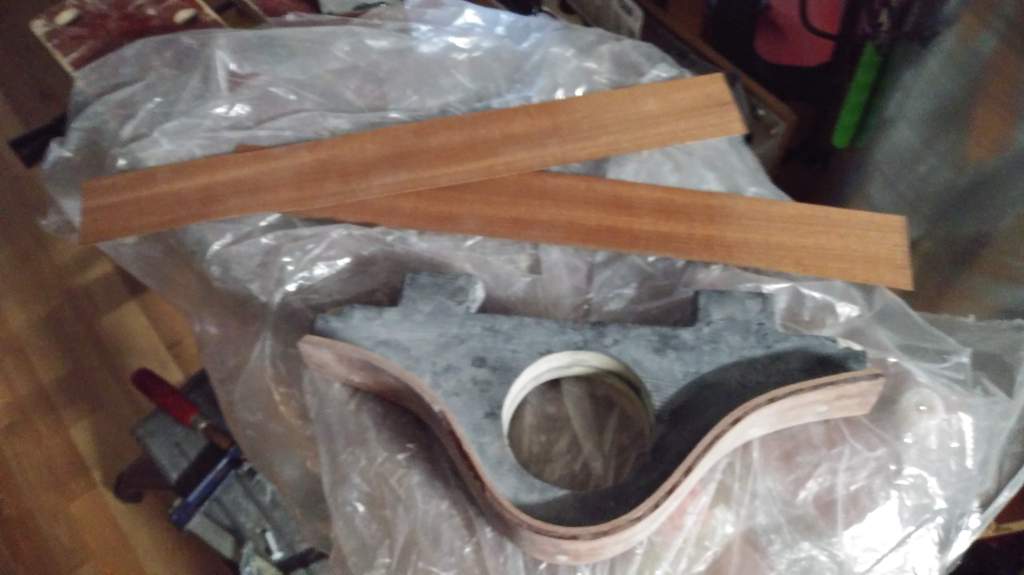
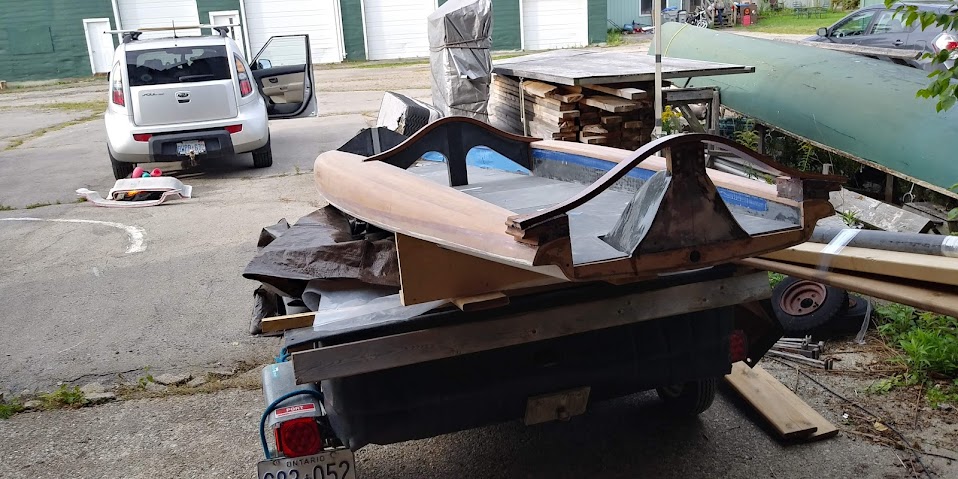
Another part recently fabricated is the top portion of the mast support for the mainmast.  I chose to mimic the arched curve in the central bulkhead and to laminate a wood rim onto this part.  The part itself is joined into the bulkhead with two mortise and tenon joints – but I had to bear in mind that with carbon/foam panel construction some extra reinforcement is necessary.  The top and bottom of the part received an extra layer of carbon fibre to act against compression of the tenons and the tenons themselves got an extra layer of carbon fibre around all sides.  This involved rounding them at the corners and then cutting the carbon fibre cloth on the bias to allow it to conform to the corners.  Finally, there is a reinforcing plate in the rear of the central bulkhead which will be screwed to the tenons – however, I had to remember to put a wooden dowel in the centre of each tenon during the initial layup, so the screw would have something solid to “bite” into rather than just foam.
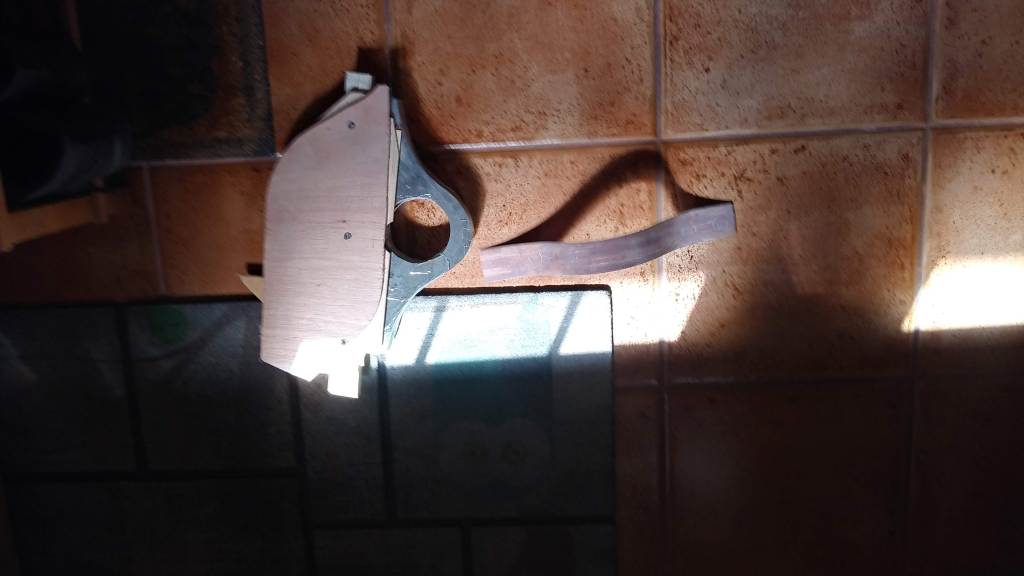
I used some veneer that Skip gave me to make this laminated edging.  It is a lovely “ribbon” mahogany that was left over from the days when Skip worked at Hudson Boats (rowing shells) and they switched over to making only composite boats, so the veneer was all surplus.  6 layers, with 2 layers of carbon fibre straddling the middle two veneers, made a very stiff shape which I epoxied to the partner and lined up with some neat plastic “nails”.  However, the clamps left some small marks on the surface, so I put two layers of veneer over the top to cover them and the plastic nail-heads.     

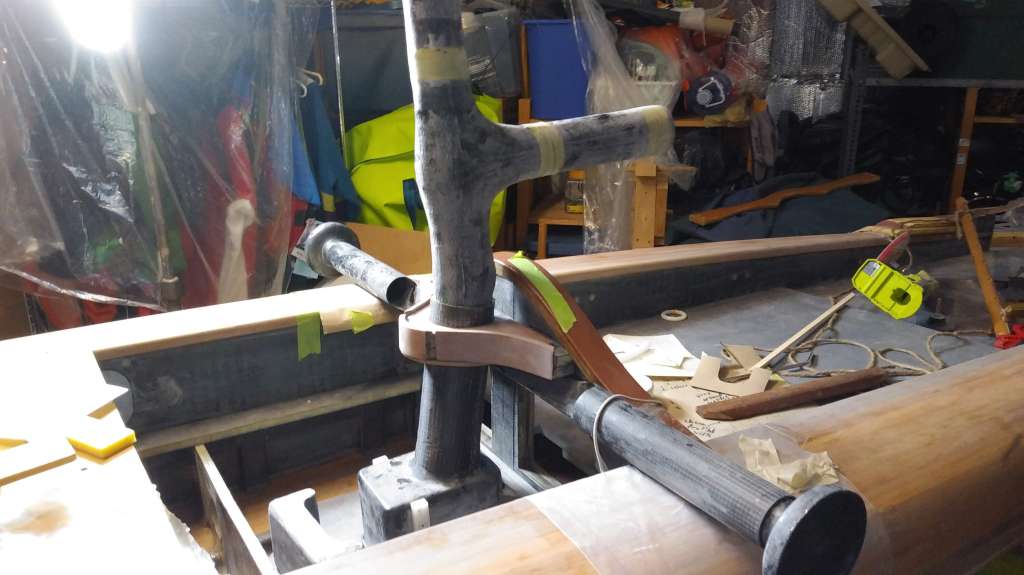
Here’s the part temporarily installed against the central bulkhead:
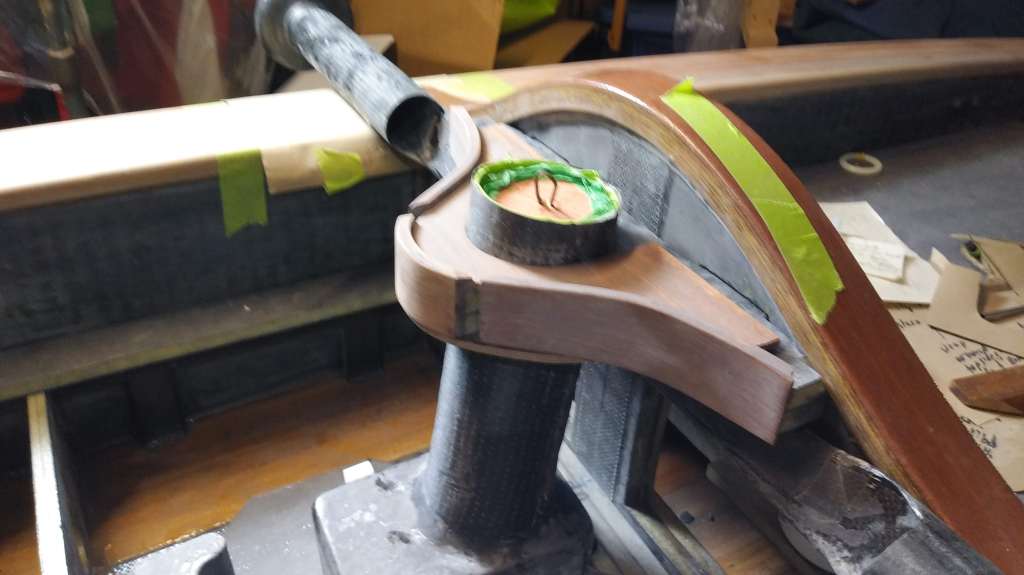
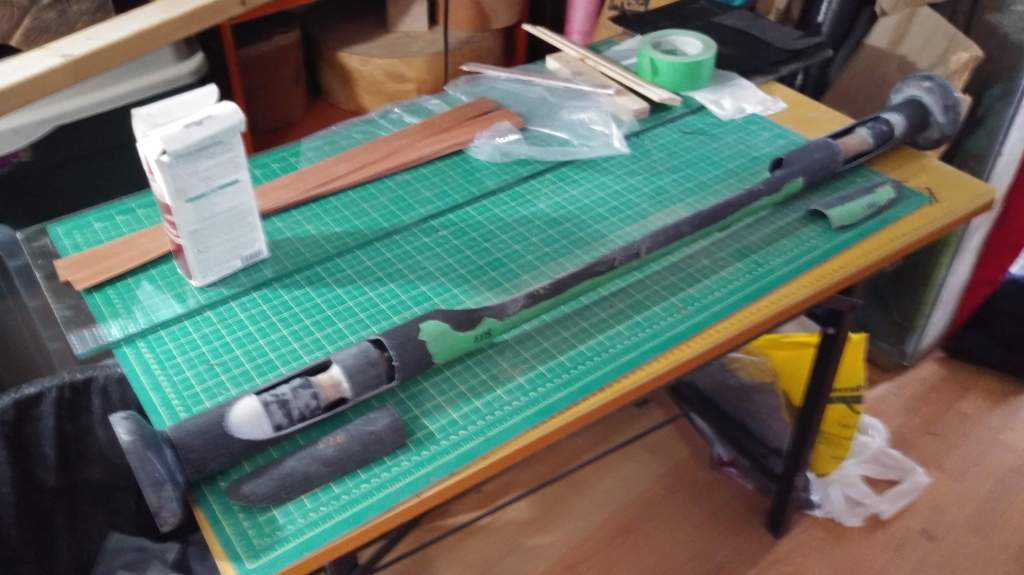
The mainmast, with its Delrin collar will fit in where the temporary wooden plug is filling the tube (green tape and a loop of wire so it doesn’t get stuck!).  The carbon fibre tube at right angles to the boat and passing under the mast support is the spar/housing for the leeboards (one on each side) and is hollow to allow a rope purchase system to hold the leeboards in position when sailing (one down and one up), allowing them to swivel to be adjusted while sailing, and letting them be removed and stowed if necessary.  Each leeboard incorporates a cone that gets pulled more or less tightly into the end of this spar/housing.  This took an inordinate amount of time and effort to plan and fabricate!    Here’s the entire assembly in its component pieces and then installed for a trial fitting:
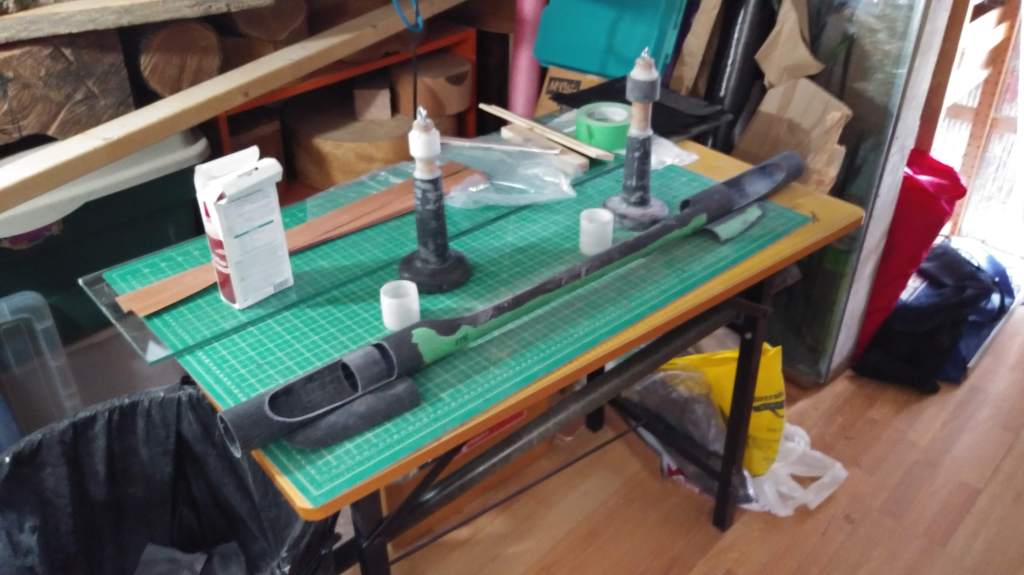
This is what I have been finding all along the way in this project – almost all of the parts have to be custom fabricated and there’s a lot of preliminary thinking and trial and error fitting before many of the parts can be installed.  I have found it’s a lot safer to test fit several parts to see that they all fit together with one another before I make a final start on the epoxying.  At the early stages of the building Skip and I went through all of the possible places where things were going to have to be attached and made sure there were good solid wood blocks epoxied in place under the deck or side-walls.  Strip-plank building is light and strong, but it needs special measures everywhere you want to attach a fitting!  I am hoping that when the floorboards are finally fastened down (they form waterproof floatation chambers under the floor) all the many requisite bits and pieces are firmly fixed in place… keep your fingers crossed!

With a view to ensuring that nothing that is being done now will cause problems later on down the line I have started planning how I am going to rig the sails and the control lines and sheets.  I started rigging the booms by inserting them into the rotating partners and then taping parts in approximate positions and running light strings through the blocks to simulate the sheets and control lines etc.  An early casualty in this process was the tiller (or how I thought I was going to control the rudder.  It would have ended up simply too long… so next I thought of separate steering sticks, a common way to steer sailing canoes.  The picture below shows a typical arrangement.
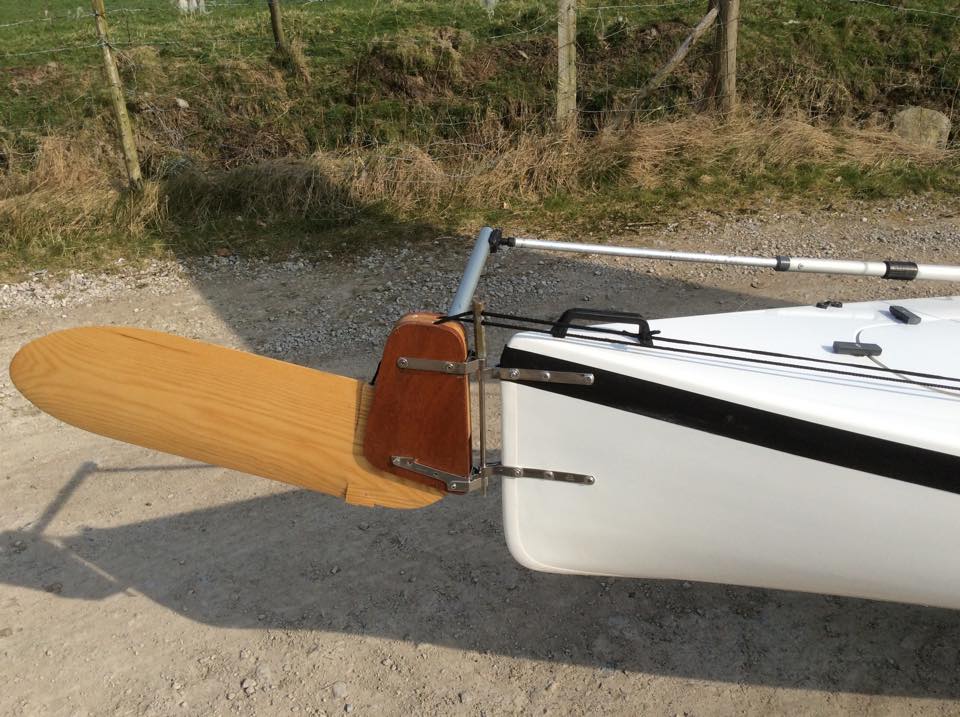
These work in the push- pull manner but depending on which tack you are on a push can make the boat head up towards the wind or head down away from the wind.  One has to get used to the new arrangement.  Some boats even have a steering stick for either side – which I seriously considered – having them crossed over in the middle with a loose yoke.  This way a push on either side would be heading up, as in a regular tiller system.   This picture is from a very nice sailing canoe (Shearwater) made in the UK (unfortunately) but I doubt whether the rowing system and sliding seat could have been grafted onto it. 

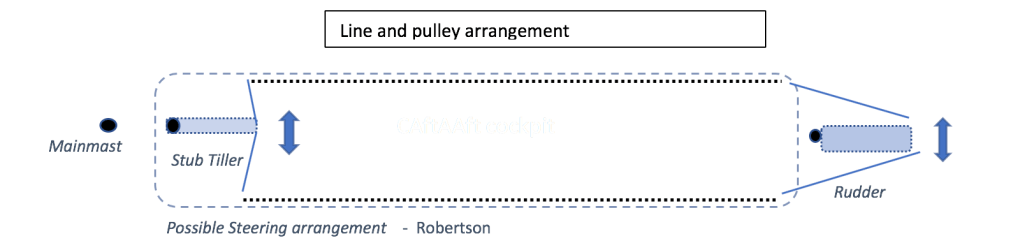
However, the mainsail and mainsheet (line controlling the mainsail) is back here, as well as a big dry-bag with most of my stuff and I could just see the sheet getting hopelessly caught up in either of the steering sticks…the jury’s still out but I am now leaning towards a linkage system with a thin line attached to either side of the rudder head and going forward along either side of the rear part of the cockpit to a shortened tiller behind the mainmast and pivoting at its forward end which effectively makes the steering back to normal:  (if sitting to windward), a push heads you up into the wind and a pull lets you bear away from the wind.   After all, I am hoping to sail the Greta T like a dinghy rather than a sailing canoe.  Here’s a schematic diagram of my tentative arrangement for steering. The line would run in a small light-weight tube along the cockpit/deck side.  The stub tiller would pivot from the backside of the central bulkhead and have doubled hiking sticks on its forward end.
So, the tinkering continues amid the big jobs of fitting the mast partners and the fore deck and making the support and attachment structure for the leeboards and the under the floor reinforcements for the rowing apparatus and sliding seat. 

Next up – laminating the leeboards using a vacuum bag!  The Old Man goes high tech!
Thanks for your interest and to all those who have sponsored and are awaiting the start of this much delayed journey… have patience, please.

(Written last year but unfortunately never published)


Well… that’s what I was going to say last year… and while it’s no less valid now, I look on it at present with quite a bit of chagrin in light of all the has happened since then.  While I can console myself with all that I have accomplished in building the Greta T  I’m under no illusions about how much more needs to be done.

Next up – The Old Man gets on with his recovery AND he finally laminates the leeboards!!!

*  Magnusson, Margareta.  The Gentle Art of Swedish Death Cleaning.  Canongate Books.  Edinburgh. 2020
Must Like Yoghurt; Strange Shapes; Holding strange shapes; Learning from one’s mistakes and Why is building this boat so darned hard?

As the building of the Greta T progresses, I have had some observations that I’d like to share with you.

This project started in the winter of 2020-21 and many, many batches of mixed epoxy later I would like to extol the benefits of eating lots of yoghurt:  yoghurt tubs (the three-pack size from Costco) make excellent mixing cups for a batch of epoxy! If you are careful, they can be re-used several times (tip:  put a string in the bottom which will adhere to any remaining epoxy and then can be used to pull out the left-over epoxy once it has hardened, leaving the container almost ready for use again -thanks to Skip).

Many of the pieces of the boat that I have had to build have required cutting out some pretty weird shapes in fibreglass or carbon fibre cloth to laminate along the curves… in particular, the new angled mast partners have “bulbs” or widened portions where I felt the stresses would be greatest ( a nice gentle curve distributes the pressure more uniformly than sharp corners).

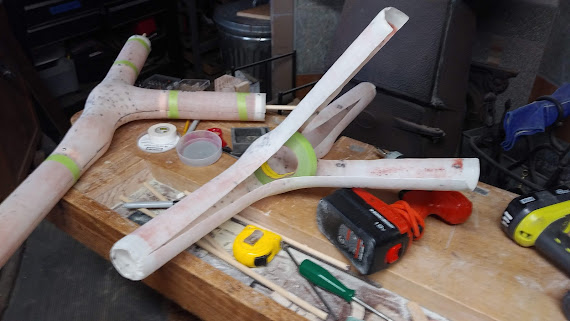
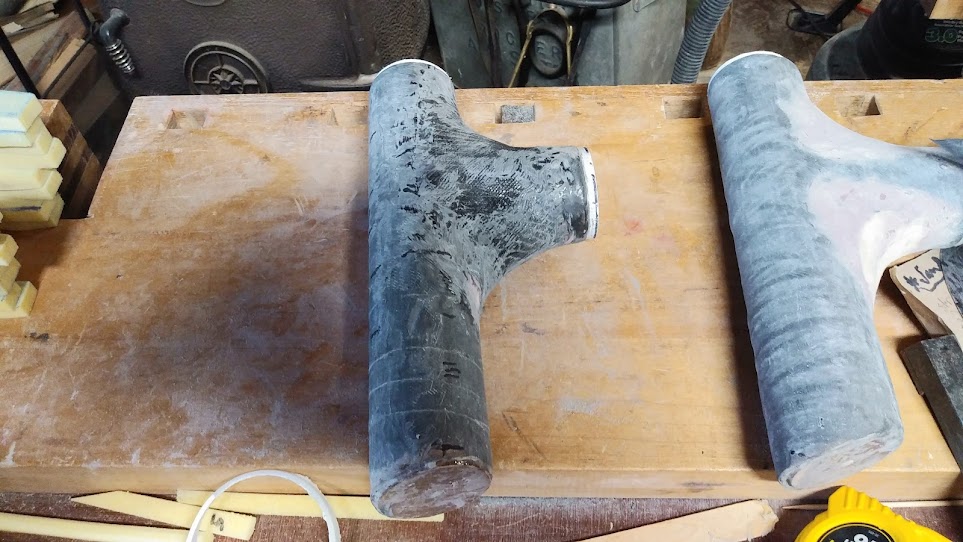
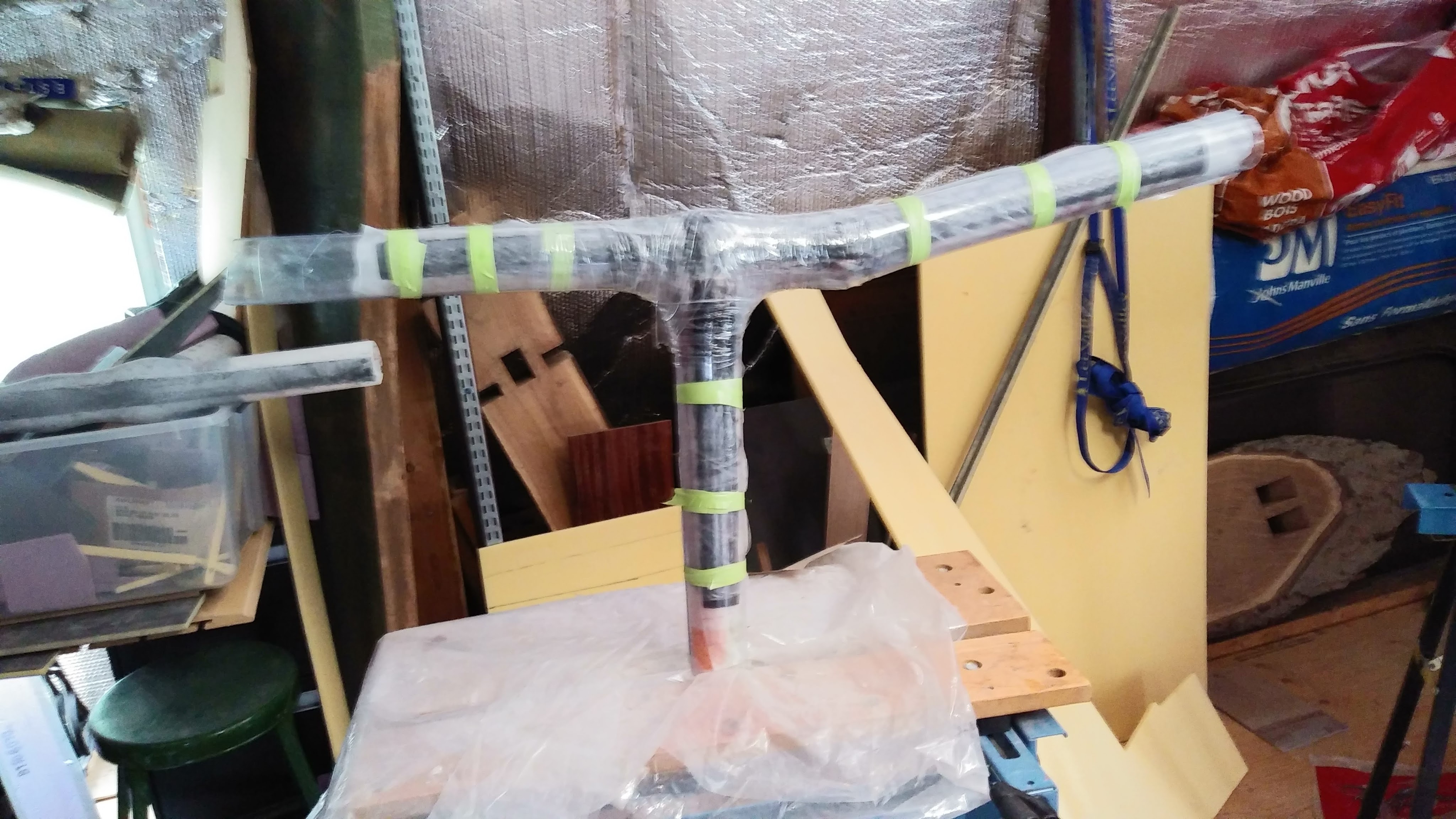
Here’s one of the stages in laminating up the partners with carbon fibre over the base form of laminated S-‘glass.

In order to compress the laminates for good bonding I have resorted to tubes cut in half length-wise for the straight portions and lots of stretch-wrap over long narrow strips of peel ply for the bumpy bits.  At this stage I have just added 6 length-wise strips of “uni-directional carbon fibre for stiffness.

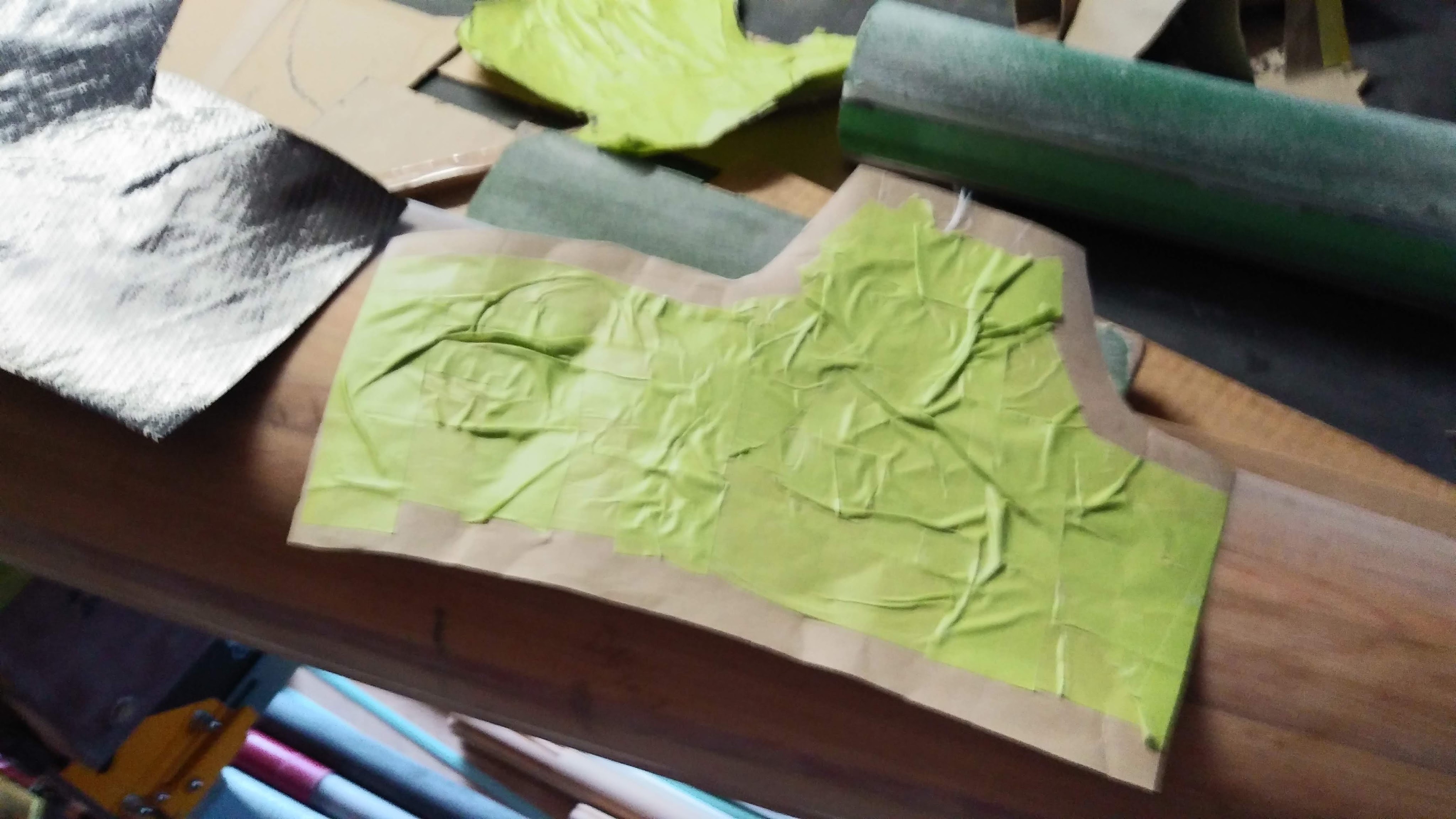
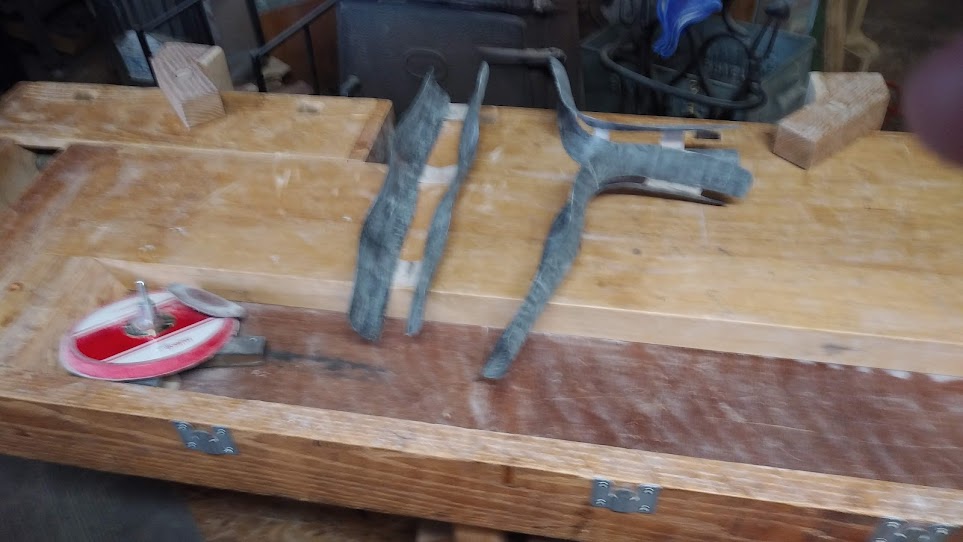
The next step is a full wrapping in “bi-axial” carbon fibre and it is here that the shapes get a bit strange.  To establish what flat shape would wrap around the partner I first covered it in two layers of masking tape and then carefully cut off along a seam and flattened the whole thing out.  Here’s what I got for a shape.

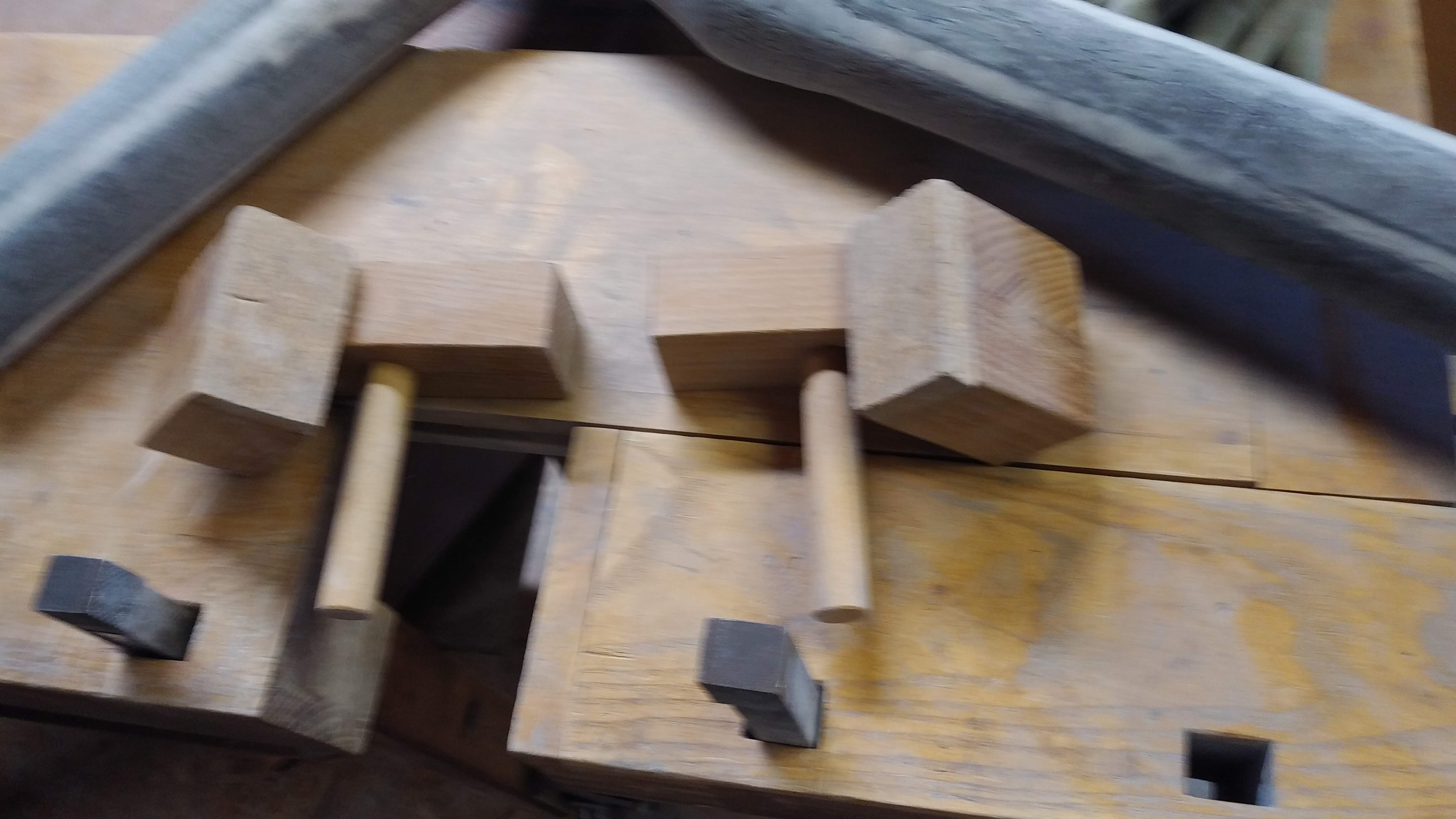
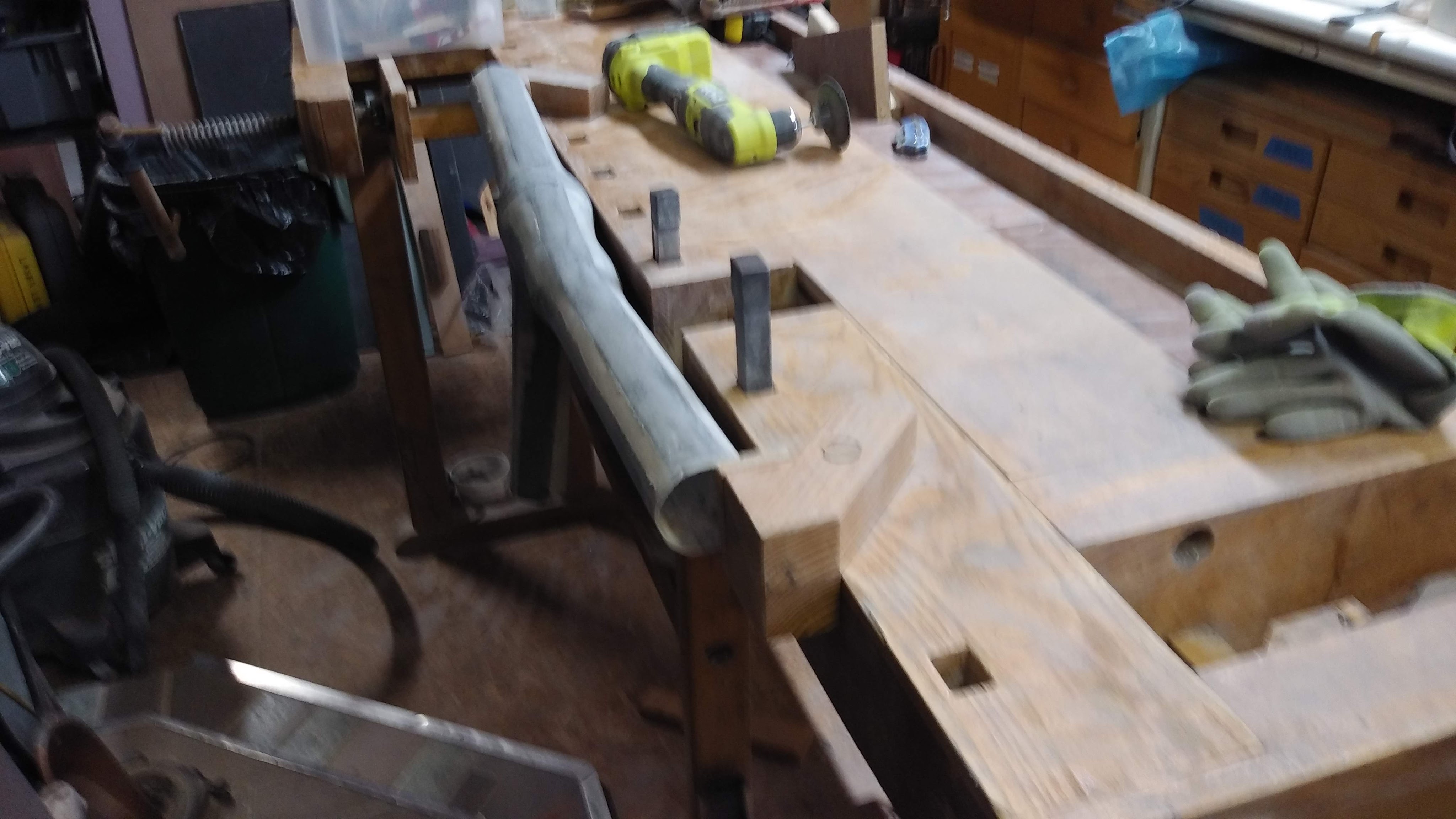
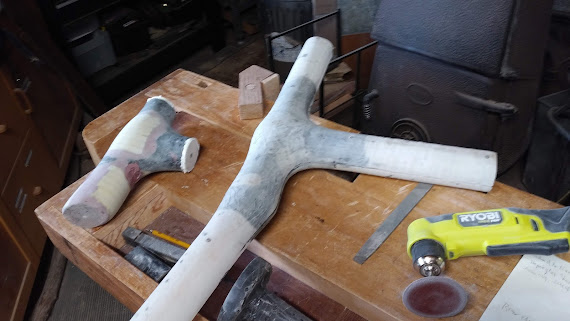
To hold some of the parts for this boat has required some inventiveness as they don’t always easily fit into a standard woodworking vise.  At various times I’ve used rope and string, weights, and angled blocks.  However one that has proved invaluable many times has been a set of angled bench “dogs” that I made from wood a number of years ago following a pattern I found in Fine Woodworking magazine (despite my best efforts I can’t find it in their archives and so can’t give credit where credit is due – it’s a genius idea!) these two pictures show what they look like and holding the awkward mast partner shape on the face of my workbench.  Alongside them I popped up the traditional cast iron bench dogs that I routinely use for woodworking.

The home-made bench dogs compared to the cast iron ones. One of the mast holder shapes is being prepared for further laminations.

Although I have made many mistakes along the way, fortunately most of them have been fairly easy to correct.  It does tend to slow down the pace of progress, however.  Here’s an example:

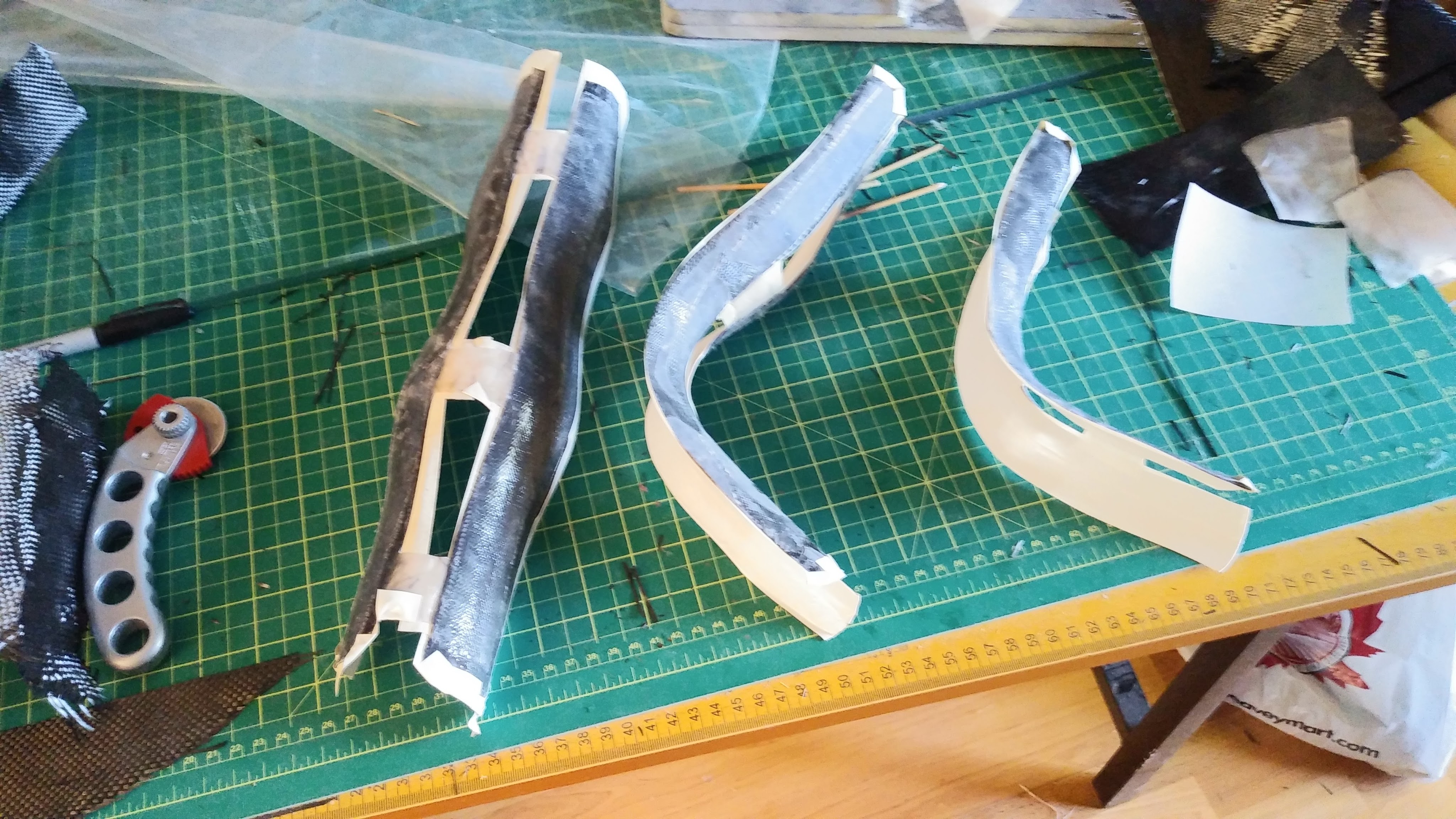
I made these shapes as a cast directly off the mold for the mast partners and used them to shape the inserts (to provide a stopper and rotation plate for the masts and booms) for the partners.  What I failed to realize was that these shapes would also allow me to apply just the right pressure in the right spots to compress the laminates I was adding on the outside to build up the mast partners.  After having a lot of trouble with the first one and having to patch up areas where the laminate wasn’t compressed enough (you can’t cut uni-directional carbon fibre on the bias to help it around curves!!!), I had an “AHA!” moment and realized that these were just the shapes I was trying to wrap tightly and they could be used on the outside with stretchy tape to squeeze the laminate close to the form at the trouble spots.  After a little modification (I made them stiffer by adding another couple of layers of fibreglass) and then I lined them carefully on the inside with electrical tape to prevent them sticking to the peel ply covering the laminate.

This went much better the second time with only one area needing repair! 

Finally, why is building this boat so darned hard?

I think I exasperated poor Skip Izon by all the “non-standard” things I wanted to be in the Greta T.   Things like the forward-facing rowing system and the tilting/rotating masts not to mention the self-draining cockpit floor and open transom.  He was a pretty good sport about it all – but I think he, like a few of my sailing friends, is reserving judgement until it all gets finished and put to the test… which is the crux of the problem – it is taking a long time to figure these things out, figure out how to make them and make sure they all work and fit together and then to get it finished.  Here’s an example:

The start of fitting the mainmast “cartridge” and aligning it with the leeboard holder with the start of shaping it to accommodate the mast.

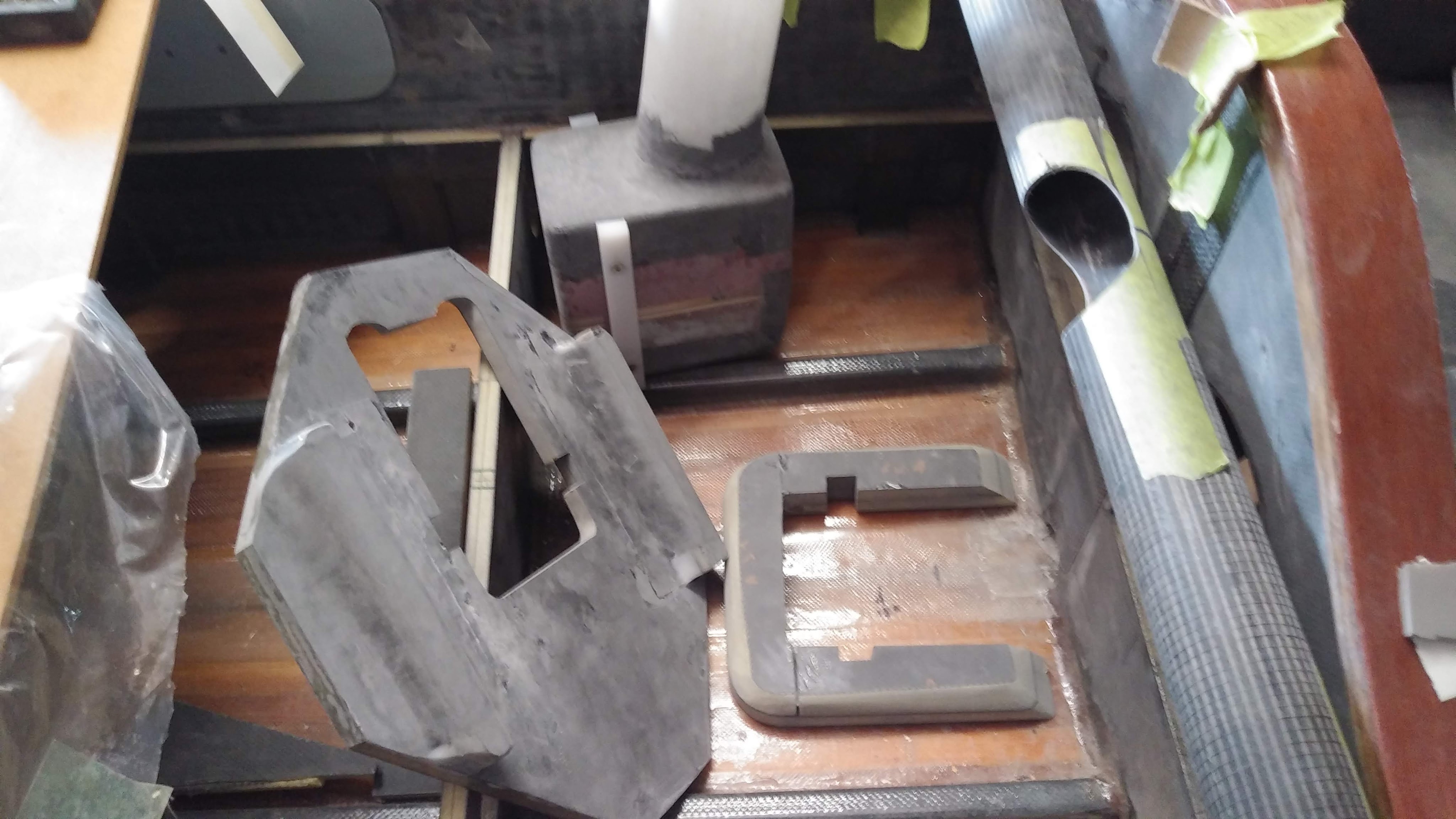
This is the mainmast “step”, or the housing that the main mast sits in and which prevents the mast from shifting as the sail puts pressure in all directions on it (the floorboard has been removed, but will be permanently fixed on top of it – the box with the tube drops down through a hole in the deck and the two plates attach to structural parts of the boat to hold the box rigidly).

 Of course, for a rotating mast this has to be some kind of tube supported by other parts of the boat such as the deck (think of a Laser)… but, on the Greta T there is no deck where this mast is and furthermore, part of the fitting is angled to allow the unique mast tilt to windward when sailing downwind, so the support tube has to be angled.  OK, so this is still “do-able” but there’s no real guarantee the tilting mast thing is going to work exactly as planned – I have the word of a Swedish designer and boat-builder, Jurgen Sass,  (https://sassdesign.net/Helsa%20Rediviva%2050-50%20eng%20pdf.pdf ) that it does, but he was too busy to give us any instructions…  To hedge my bets somewhat I decided to make the mast steps “removable” and easily swapped out to hold an upright standard mast…  you can see where this is heading, can’t you!???  It’s a good thing I am bald as I would have tugged what few hairs I might have had remaining at this stage of my advanced years, completely out.

I have made “cartidges” that slide into place and are held down by a plate on the top (in the foremast, this plate forms part of the deck); on the mainmast, this plate fastens to the floor with reinforcements underneath.  The challenge has been to keep the fit snug and supported on all sides, but not too tight that the cartridges can’t be swapped out for ones to hold the masts in an upright position if that proves necessary.  The carbon tube going from side to side is the start of fitting the leeboard supports. 

Here’s the mast “partner” fitted into the central bulkhead. The tube for holding the leeboards has been removed but will fit under this and behind the main mast.

Another area is “retrofitting” attachments for the leeboards.  These are boards that drop down at the sides of the boat to stop sideways drift while under sail and channel the force from the sail into forward motion.  Unfortunately, we decided late in the build that the dagger board system (through a slot in the centre of the boat) wasn’t going to work with the sliding rowing seat.  However, we were well past the stage where we could have installed “tubes” through the hull to house the new leeboards.  So I have had to come up with an add-on that will be strong and keep the point of attachment/pivoting as low as possible.

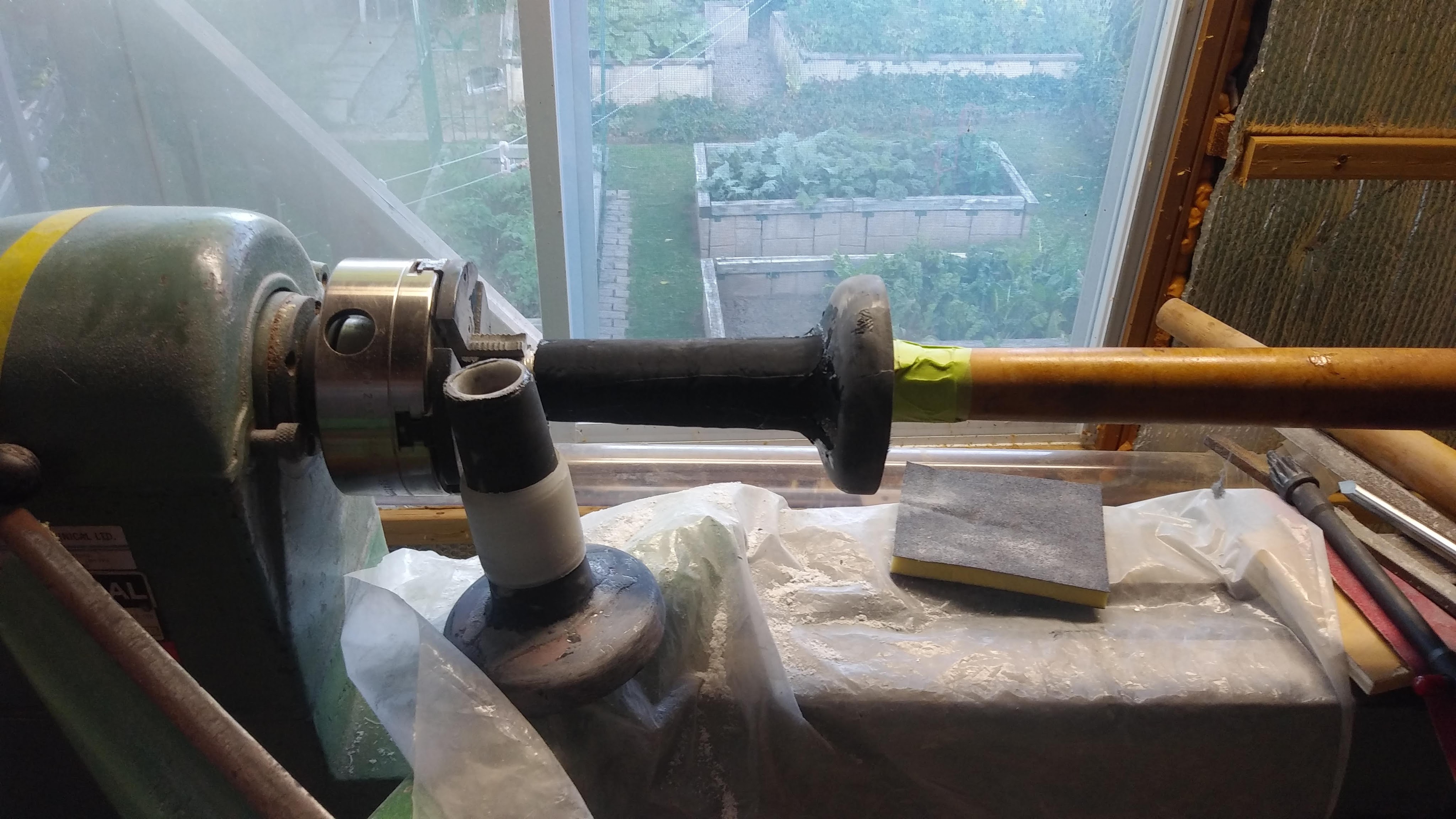
  In an effort to save weight rather than using a piece of metal tubing I made a mold and laminated two pivots from carbon fibre.  After truing them up on the lathe I laminated the shaft with a special fabric (Dynel) set in epoxy with graphite powder added to make a low friction hard wearing surface as these two parts (once they are ‘glassed into the leeboards) will be under a lot of pressure and wear as they rotate.  These pieces will be laminated solidly into the structure of the leeboard.   The piece not on the lathe has a nylon collar that I turned for low friction as well.  

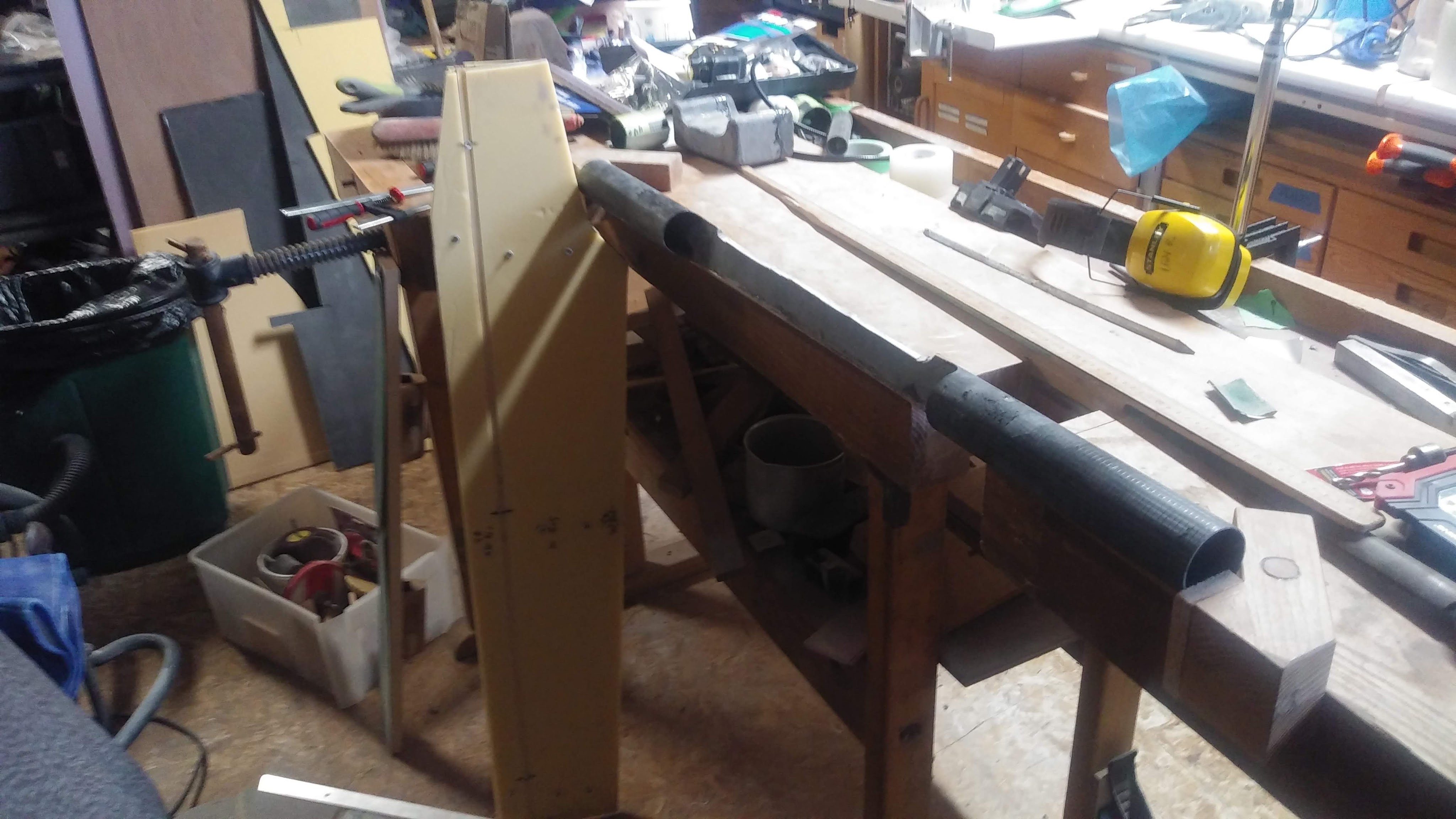
 Here is the leeboard holder (with the cones inserted) which has had plastic “bushings” inserted inside to allow the  leeboards to swivel, but with enough friction that they stay in place while sailing.  This will be adjustable by pulley and rope system pulling them inboard and as the supports are conical, it will allow variable pressure to keep them in place.  I also wanted the leeboards to be easily removed from the boat in case it is needed going through the locks of the Trent Severn Waterway.

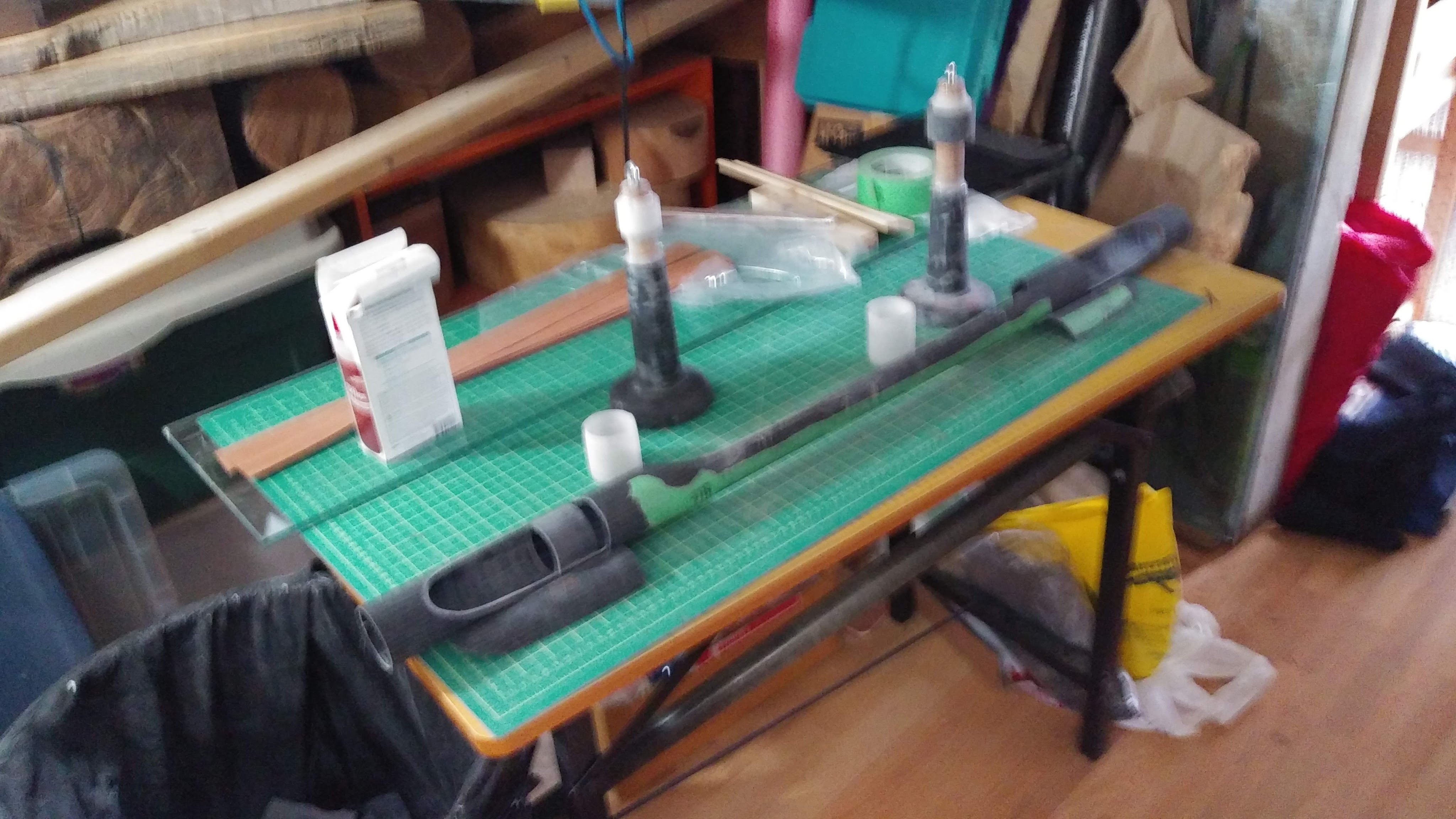
The leeboard spar which spans the width of the boat and takes the cone shaped pivots in either end.

Here’s a picture of the support for the leeboard and one of the leeboards (as yet un-laminated and stiffened with carbon fibre). 

One of the leeboards (un-laminated) and the supporting spar.

I am thinking of forming a society of masochistic boat builders ( the acronym SOMBBIR suggests itself – the IR is for Ian Robertson as I suspect there will only ever be the one member). 

In the words of Bill Patterson (the creator of the cartoon strip Calvin and Hobbes) : 

“You can’t just turn on creativity like a faucet. You have to be in the right mood.
What mood is that?
Last-minute panic.”               

https://www.goodreads.com/quotes/tag/procrastination

And so, still short of last-minute panic, and reminding myself to try to keep a sense of humour about this whole endeavour,  I continue to plug away at the Greta T .  I have had to accept now that realistically it is unlikely that I can get on my trip this year… a good outcome would be to get the boat in the water and test it in the Autumn.  I have re-installed the rowing system on my canoe and plan to get out for rowing training once or twice a week. 

Thanks to all those following this saga and to those who have generously donated to the WWF.   Please continue to watch this space.

Keeping my nose to the grindstone…

A lot of details have been worked upon since my last post, so I thought I’d provide everyone with an update of the progress in the building of the Greta T.

Of course, Spring, a new sailing season at both clubs to which I belong and volunteer (Water Rats in Toronto and Hamilton Bay Sailing Club), restoration of a very old and tired Laser as an addition to the HBSC’s two Lasers, and gardening have also been making their claims on my time as well.  I find I don’t have any trouble getting to sleep in the evening these days….

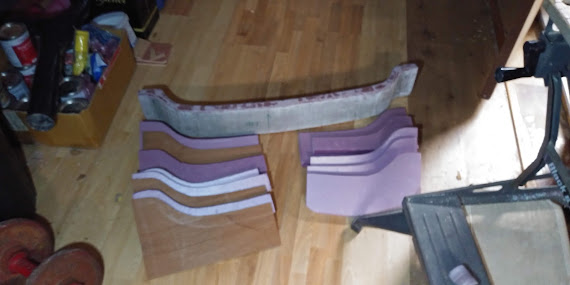
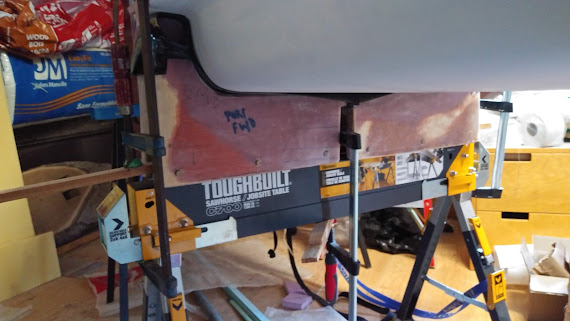
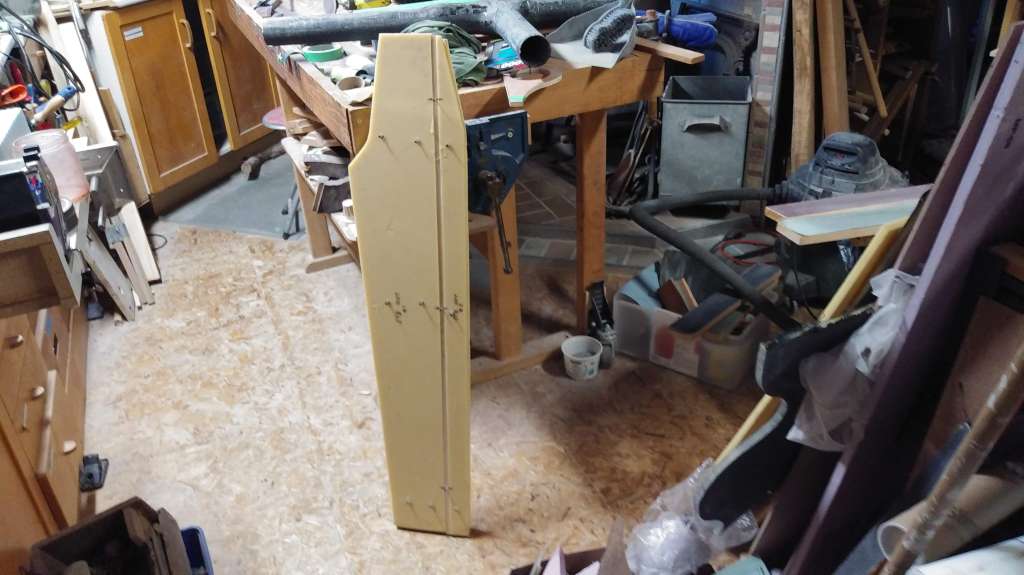
One of the last things I did before leaving Grand Bend and bringing the boat home for completion was to have Skip make two “castings” out of foam and fibreglass from two sections on the hull.  The aim of this was to have the forms that fitted the shape of the hull in order to make “bunks”, or holders for the boat when it is on a trailer.  I had used these, mounted on two saw horses, to hold the boat while I work on it – however they were not fitted with any wooden parts to properly fasten them.  I decided to finish this job, figuring that all the skills I would need were going to be ones needed for the actual finishing of the boat and what better way than to practice/learn these skills before having to do the actual jobs on the boat itself.  Finishing these two bunks gave me lots of practice in fibreglassing, making fillets, fairing with epoxy filler – and all my mistakes or less than great work could be hidden and wouldn’t make such a critical difference as this was all going on the trailer; it just had to be strong, not especially pretty. 

Here’s what I started with: the aft bunk that Skip made is on top. Below it are the sections (scrap foam and plywood) that I added to make it mount securely on the trailer.
After much laborious epoxying, glassing and fairing, here’s what I ended up with – the forward bunk now clamped to the saw horses and holding the Greta T  quite snugly;  the clamps are a concession to the way I need to fasten these bunks to my trailer – it didn’t fit the sawhorse very well, but that was just a temporary thing.   I sure learned a lot (and made more than a fair number of mistakes) making these.  I also will be “practice painting” these before I tackle painting the boat itself. 

Next, I’d like to update you on the re-build of the mast partners.  Although a long and challenging job, it has gone well, and I am pleased to say that I think they are at least strong (and I know they are a LOT lighter) than my first set.  This idea (of a bent mast holder in order to lean the masts to windward while sailing downwind) was taken from a design brief by a Swedish boat builder/designer (https://sassdesign.net/Helsa%20Rediviva%2050-50%20eng%20pdf.pdf) but unfortunately, when contacted, he was too busy to offer any details on how to actually make it!  So I have had to stumble along as best as I can.  If you’re interested in sailing canoes, I encourage you to read the article.  It’s a pretty neat little boat!

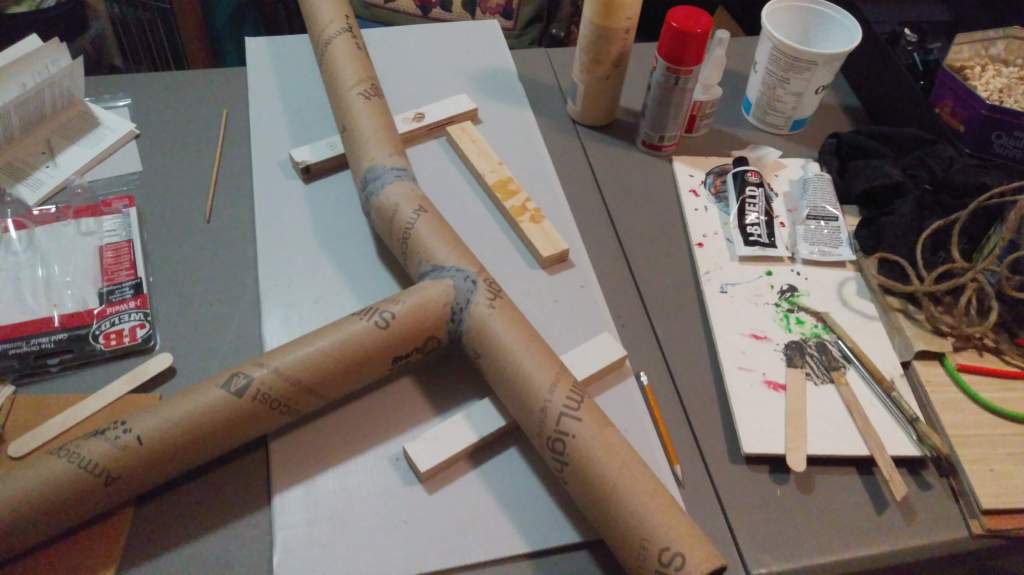
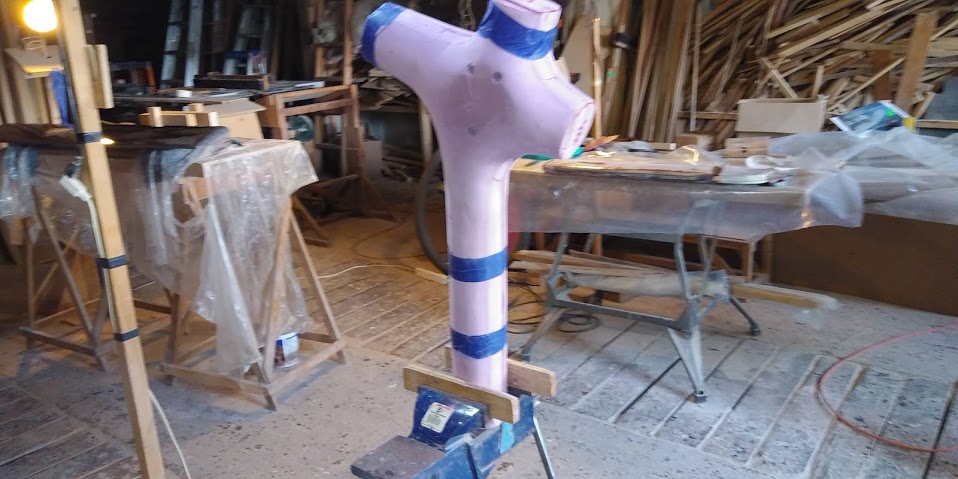
It started with making the male mould of the partner (I am making the foremast and mainmast partners identical and building a third one spare as insurance against breakage).  A cardboard mailing tube, Bondo, tooling gelcoat and lots of elbow grease were involved!

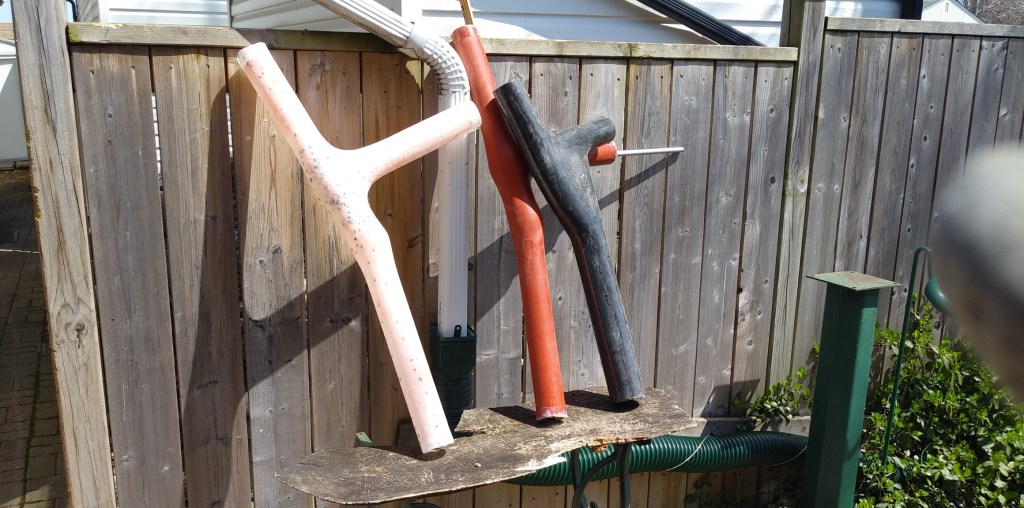
Here you see from left to right:  the partner off the mould, the mould and the old partner.
 
I was able to “butterfly” the partners off the mould, hoping to keep them aligned.  Each part is being left intentionally long before final fitting in the boat.  At this stage these are only made up of couple of layers of fibreglass so they are still pretty “springy”.  After inserts to position the masts and boom are installed, these will be given several more layers on the outside with two types of carbon fibre cloth (uni-directional and biaxial) to provide the required stiffness.

Next, I made ( using a mailing tube again!) and shaped with foam two hollow inserts to fit inside (these will stop the mast and boom at the right depth when they are put into the partner). 

You may spot that the top and middle ends of these inserts have white disks on them.  These are cut from a piece of very tough slippery plastic ( I salvaged some of the old boards from the Peach King Hockey Arena when it was torn down!).  This will allow the mast and boom to be easily rotated. 
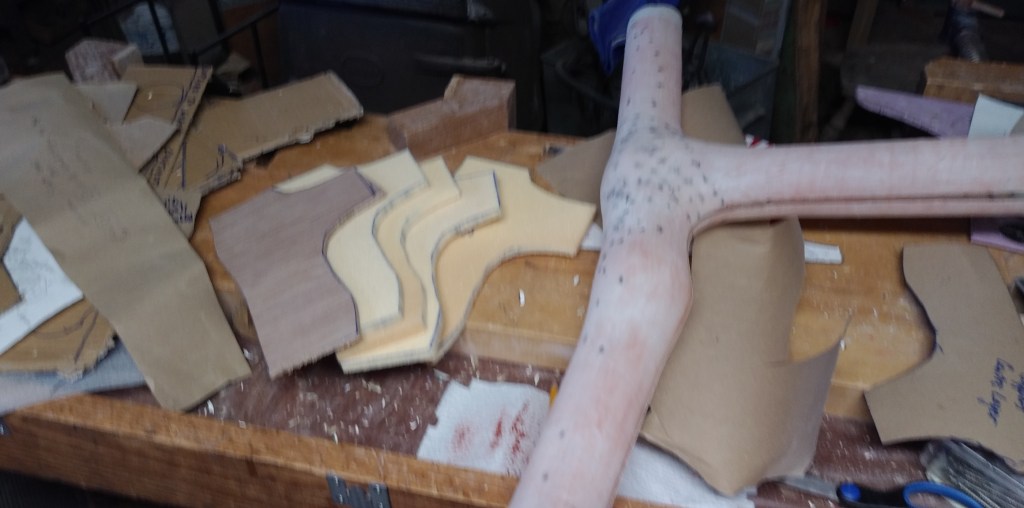
Here, foam “horseshoe” shaped pieces are added for shaping the inserts to exactly fit into the inside of the partner moulding.
The curious squiggly pieces in this photo are pieces I made directly off the mould and used as patterns to help me grind the foam on the inserts into shape for a snug fit inside the partners.

Next, I ran into a “technical difficulty”.  As much as I wanted to keep the partners in one piece just as they came off the mould, I couldn’t think of a way to position and epoxy the inserts inside securely and accurately – and without voids.  It was just too much of a struggle to fit it in place!   The decision was made to cut the partners in half, lengthwise, and ‘glass and epoxy in the inserts and reattach the two halves.  I made a jig to keep everything aligned while this was done.  The wooden disks are taped to prevent epoxy from sticking and then held in alignment by the dowels and small screws through the fibreglass of the mast partner.  Happily, these disks pulled out without too much trouble once the epoxying was done!  I admit that I was holding my breath!

Here’s the result, ready for its outer layers of carbon fibre for stiffness and strength.

The insert, with biaxial carbon fibre around it, is inside this middle part of the partners where I figure all the stresses of the mast and boom are going to be concentrated. The second insert (for the foremast) is alongside for comparison.  

This project has certainly been a lot more than I had initially bargained for… and that’s largely down to my decisions to go with a lot of untested and somewhat radical ideas for the sails (angled masts, furling etc.) and the rowing (forward facing) and the shapes and construction by strip planking of the hull.  Virtually everything has to be hand fabricated and unfortunately I spent a lot of time making a daggerboard that we decided to replace with two leeboards (partly finished now)!  All of this has certainly been a steep learning curve for me and at the same time I have learned a lot about myself:  the Old Man in this boat is a slow worker and takes a lot of time to think things through! Still, I reassure myself with the thought that this is very probably the only boat I will ever build (no, it is the only boat I am ever going to build!) so I might as well try something different. 

It’s clear that there is still a lot more to be done and it all will take time before the Greta T is ready to rock and roll – and that’s somewhat discouraging.  I also resolve not to let the recent Ontario election results get me down! … no, really – I’m only at the gnashing my teeth stage.

However, I continue to plug away at the boat and prepare for the Old Man in a Boat Tour, encouraged by my supportive family and by the kindness of offers of places to stay and help along the way from donors who live or have cottages close to where I will be passing.  I’m pretty certain you will see me this summer!

The Old man is back…

You could be forgiven for thinking that the “Old Man in a Boat Tour” has faded away uncompleted – but… we’re back in action! … after a rather unproductive Fall and Winter.  As I write this I am looking back at a blog post that I had written (but never published) in October (2021).  I must confess that I somewhat lost heart for my project these last few months as the cold limited my work (the workshop isn’t heated) and I struggled to design and build some of the new features required by the changed plans made upon bringing the boat home from Grand Bend.  The rise of Omicron, the relative failure of COP 26 regarding action on climate change and the impending threat of Russia’s unprovoked invasion of Ukraine were part of a daily pressure that certainly also added to my rather bleak state of mind. 

So… what has changed? 

A couple of very generous and heartfelt donations just before Christmas pushed our total to just under the $9,000 mark and made me realize that other people share my concerns about the environment and want me to be successful in my project.  That was very heartening.

In addition, Mindfulness training; my Recovery training (https://recoveryinternational.org/) which I learned from my mother, Madeline Robertson, who was a Recovery Group Leader for many years; continued fitness training and practice of Tai Chi/Qigong; and most importantly, the steady patient support of my family – all these have got me moving forward again. 

So, I’m going to publish what I wrote in October (along with pictures of the progress on the boat) and then I promise to bring you much more regular updates on how the work is proceeding.  Come the proverbial **** or high water, the Greta T will be in the water by the end of June!


Unpublished Blog post for “Old Man in a Boat Tour”                         October 20, 2021

Have you ever had a time when you felt the wind had gone out of your sails – either figuratively or literally?  It seems to have happened to me for parts of the last month and this one since bringing the Greta T home from Grand Bend to finish.  Life has taken over – yard and garden work that needed doing urgently (including picking up over 200 lbs. of walnuts from the enormous walnut tree in our back yard!); an increasingly sore knee that turns out to be a cyst and strained tendon attachment; a feeling of discouragement at the size of the task of finishing the boat on my own; and a seeming mountain of paperwork that had piled up while I was up in Grand Bend for so much of the summer.  All this with the steady clamour in the background of the urgency for action on climate change and a national election that really changed nothing.  My beloved Green party seems to have descended into total disarray as well. 

In short, I have had a dose of the doldrums – but it’s time to get back to the project.

On a brighter note, I did manage recently to get to a Laser Masters’ regatta/clinic up on beautiful Georgian Bay which was hosted by the very friendly folks at the Thornbury Yacht Club.  My friend from the HBSC, Orest Ostapiak, and I travelled up a few weeks ago and had a blast on both days as the wind and weather both co-operated despite the forecast and we had excellent coaching from Lee Parkhill (Canadian men’s Laser entry at the Rio Olympics) plus numerous short races. I paid the price for all that leaping about in the boat – I was hobbling for a few days afterwards!

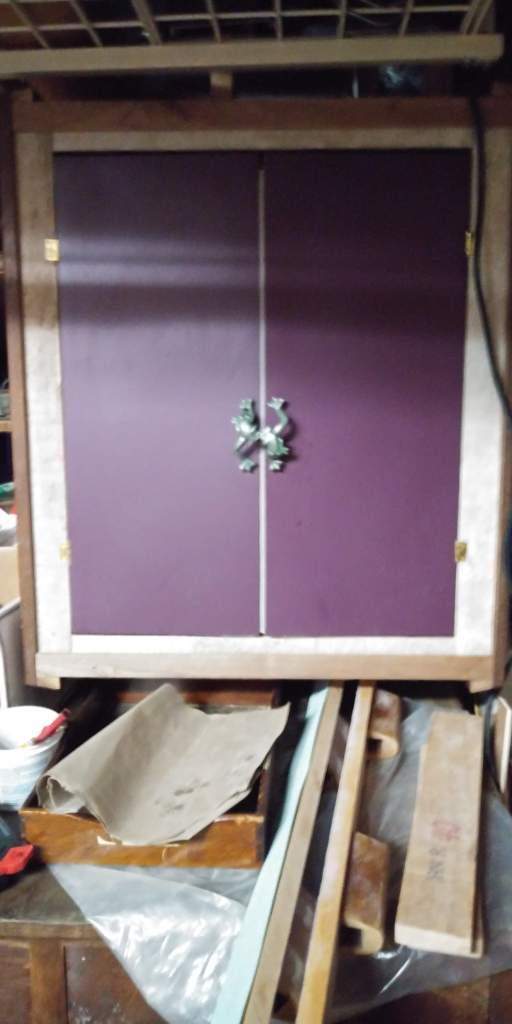
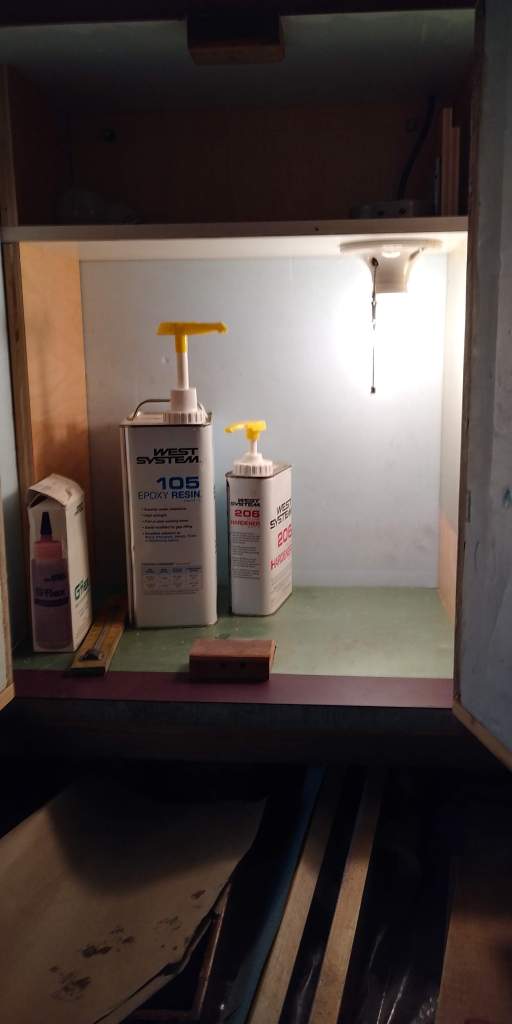
So, what about the boat building?  I started to tackle the transom and very quickly decided after numerous trips up and down stairs from the loft to the workshop that I needed to equip the loft a bit better for working.  I built some tool racks and installed a vise so things would be close at hand and I built an insulated box for keeping the epoxy warm.

The challenge with the transom (flat surface at the back end of the boat) was to provide enough surface off which to hang the rudder since the stern is open to drain the boat (the floor slopes downwards fore and aft) . 

For stiffness we had laminated another wooden “arch” to mimic the one at the midships bulkhead which will support the mainmast.  However, at the stern I had to build up the sides to get enough clearance for the rudder, and the challenge was then to make this a smooth transition for the water to flow over as the boat heels and the quarter (stern corner of the boat) enters the water.  The solution was to glue up close-celled foam shapes(shaped by heating) on either side and grind/sand these into a hydro-dynamic shape and then ‘glass over these.

Mast partners are what hold the mast in place, but in this boat there is a bit of a difference:  the actual “partner” that holds the mast is bent at an angle to allow the masts to tilt when sailing down wind. I designed and built a version when I was working in Grand Bend but once home I came to realize that they were too heavy… so I am rebuilding them and hope to achieve a good weight savings and that they don’t look quite so clumsy.  Then the challenge of supporting them – especially the forward mast  – required me to design and build a holder that fits under the deck for the foremast and under the floor for the mainmast.  The time-consuming part is building this as a “mock-up” to get the dimensions and angles correct, and then finally building it with ply, foam and carbon fibre.


Now to the present – April 20, 2022.  Not much has changed on the issues that were my heavy preoccupations in the fall:  climate change inaction, the daily horrors of the war in Ukraine, and the on-going prevalence of Covid and the threat of its new variants.  However, these are certainly issues that are largely beyond my control, although I can continue my efforts to keep my carbon footprint small and keep my project as environmentally friendly as possible.  As to Covid, I have been for my second booster and continue to wear a mask when shopping and working at the boat club while fixing up an old Laser that I am donating to them.  After the craziness of the protest in Ottawa and the relaxing of mandates in Ontario I’m just keeping my head down trying to stay safe for myself and others. 

As to the Greta T, I am pleased to report further progress in that I am ready to make both of the mast partners from the mould which I built and the forward mast step is almost finished.  Boy, making that cut through the deck was pretty nerve-racking – I must have measured it five times before daring to pick up the saw!

The deck is fitted, cut open and the forward mast support holder in place but not yet trimmed.

The forward mast support holder is a lightweight foam block built in layers with carbon fibre reinforcement between each layer and a tube to hold the mast support installed at the same angle as the mast support’s bend. For such a plain looking object there is sure a lot going under the hood!

The forward mast support holder removed from the deck.

I promise to keep up with more regular updates of the work and the progress towards launching and setting out.

Many, many thanks to all who have shown an interest and/or donated to the Old Man in a Boat Tour.   The “old man” is working hard to repay your trust and support.

The end of a chapter, but the saga continues

After steady hard work over the summer, the Greta T is now back in Grimsby to be finished. The pandemic lockdowns and increased summer rates for motel rooms have put a real dent in the building budget for the project and reluctantly I decided that our final two weeks of work would have to focus on what Skip Izon could do that I couldn’t, and so began a very concentrated effort: fit the deck and make the molding for the coaming; build the forward mast support structure for under the deck and finish the floor where the sliding seat is located. I am happy to say that all of this was achieved, while I managed to get the transom structure and rudder post installed and the mast partners finished.

With a very laden trailer (full of all my tools and the remaining building supplies) and the Greta T well snugged down and tarped on top, I made the long journey from Grand Bend back to Grimsby. I owe a big debt of gratitude to Skip for all the extra help just in packing up and loading and to Skip’s partner Elizabeth who gave us a much needed hand on the morning of the move and for being so understanding of the very full work week that Skip was undergoing for the last several months in order to build this boat.

It has been an intense experience working away from home so much and for such long hours – I am glad that Skip and I built up what I consider to be a real friendship during the time. For two such stubborn old guys that’s an achievement! I have learned so much from his 40+ years of boatbuilding experience and his patience in putting up with my very modest boatbuilding skills (and my terrible puns).

At the Grimsby end, June and Maya had tidied up and created a great working space in the loft above the garage and with the help the neighbours (thanks to Steven and Ted Allingham) we installed the boat in its custom made “bunks” on two sturdy sawhorses. A couple of days have been spent organizing this work space and then I can begin again in earnest.

Below you can see some more details: the oval side storage compartments (taped over in earlier pictures) and the rowing seat in place. The floor (black panels with tape on them) slopes downwards to the stern so the water will drain out automatically, however to get the sliding seat a low as possible in the boat we built a “well” for the foot stretchers, and this will probably have to be sponged out the old fashioned way. You can also see the grey supports for the forward rowing system.

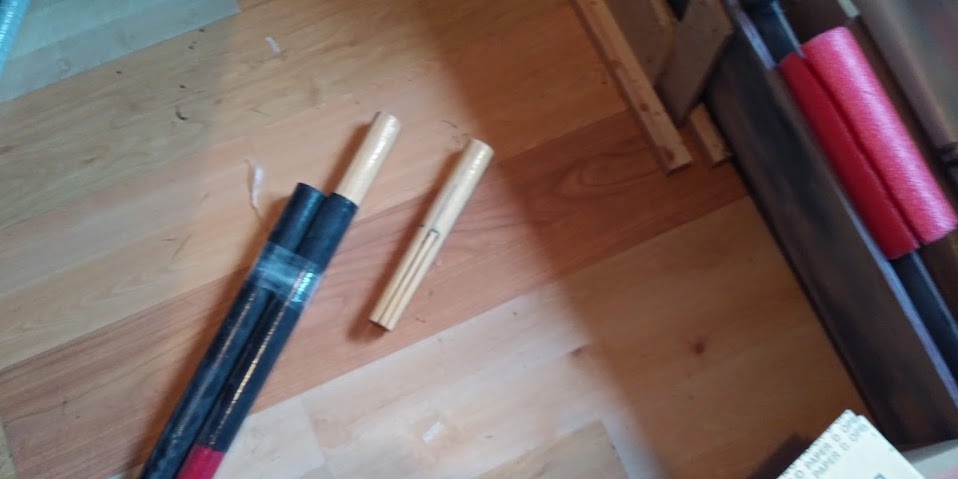
Finally, a bit more about the masts and the mast “partners”: the old windsurfer masts have been reinforced at their base with a carbon fibre sleeve and extra strengthening plugs which I turned on the lathe from sitka spruce are ready to be inserted in each mast and boom. The end of these plugs that is furthest into the mast is drilled out and cut to form long “fingers” (which are not epoxied to the inside of the mast) with the aim of making the transition from solid wood to a more flexible portion which will allow the masts and booms bend more smoothly rather than with an abrupt transition where the wooden plug ends.

The mast partners have been laminated with one layer of carbon fibre (unidirectional) and then faired prior to adding a second layer of bi-axial carbon fibre. You can see these above in the picture where I lashed them in roughly their final positions in the boat (the main mast is about 5” too high as it will go through a hole in the floor to the mast step at the bottom of the boat. In the second picture you can see the unique feature of the sloping mast partner: as it is rotated (easing the sail out) the mast tilts to windward, keeping the main part of the sail over the boat for better efficiency and balance. I told you this boat was really different!

So the work continues, with a hope of getting in the water early in October in time to get some practice sails and rowing training.

Details, Details, Details

There’s an old saying: the devil’s in the details and we have been truly be-deviled in building the Greta T. As a completely new boat with many unique features, Skip Izon (the builder) and I have had to do a lot of problem solving. There are no blueprints to guide us other than Skip’s lines drawings. Here are some particular examples that may be of interest. As well as describing how we made some of the various parts, I have included a few pictures to show the progression of the build.

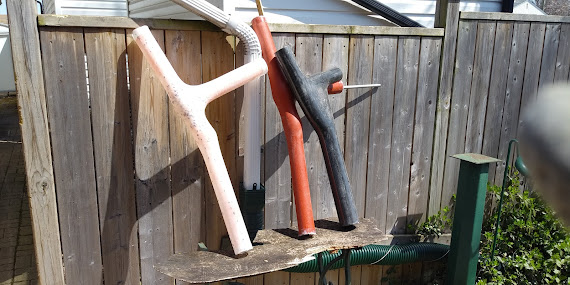
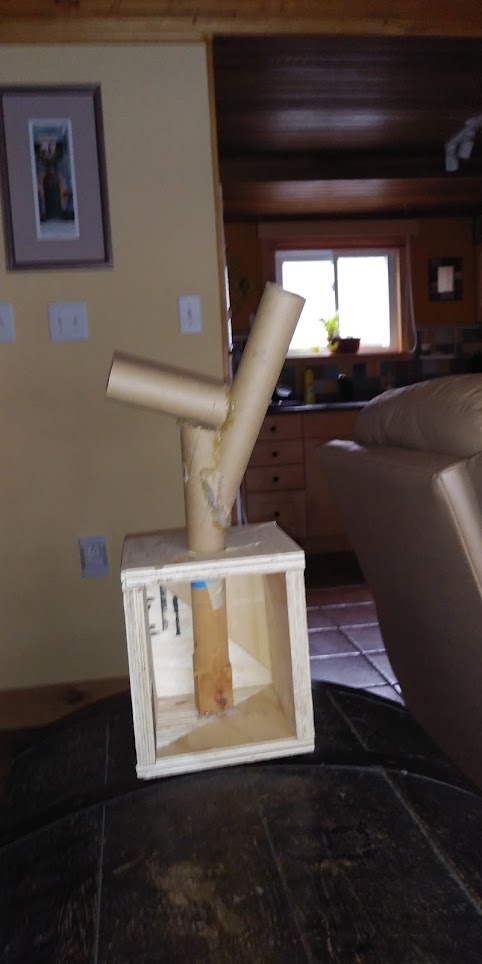
The mast holders and their supports: The challenge was to create “receivers” for the mast and boom that would be held together at the correct angle and would, together, swivel at a 15 degree angle to the vertical. This is what causes the mast to cant to windward when sailing downwind rather than heeling the boat, and keeps the centre of the sail’s power over the centre-line of the boat when sailing downwind with the sails eased out. The two pictures of the prototype mast holder, one from the side, and the other from the stern with the sail eased shows this.

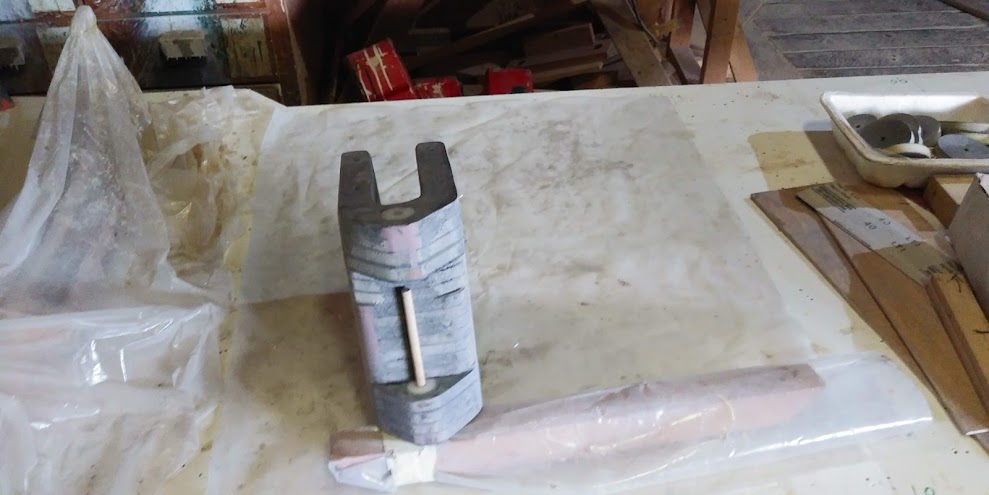
The third photo (above) shows how I am building this. After creating fibreglass tubes from the ends of the masts and booms, these were held in a holder at the correct angle and then ‘glassed together with fillets created at the joints. These will be shaped, have the bottom section attached and the whole unit will be reinforced with a wrapping of Kevlar “tow” and biaxial carbon fibre to create lightweight yet immensely strong units for both the foremast and the mainmast.

The daggerboard case: Here, moldings were made in fibreglass and carbon fibre from the forward section and the trailing section of the daggerboard. These will be connected by reinforced “walls to create a case that is slightly longer than the board is wide, so that a narrow foam insert can go in either the front or back to allow adjustment of the “helm” and to provide some give in case of going aground. It’s going to be a tight fit to get the rowing unit, the daggerboard trunk and the mainmast support into the available space, so if it’s needed we are considering off-setting the daggerboard trunk from the centre-line and then linking it to the mast support so they reinforce one another.

The rudder and its supports: Below you can see the head of the rudder – this will hold the rudder blade and allow it to swivel and attach it to the stern of the boat. It was created by laminating “U” shaped carbon fibre and foam sandwiches and then shaping the stack. The dowel shown is through the bottom “gudgeon” which is a very hard wearing and slippery plastic called Delrin. There are two, both aligned to fit over the “pintles” which will attach to a post at the stern of the boat. In the side view, you can just see (near the bottom of the brown middle section) the pilot hole for the pivoting bolt. There is still a Delrin insert to go here as well. The issue of weight is critical especially weight at the bow or stern of a boat and I am pleased that the entire rudder and its fitting came out at about 7 pounds – lighter than a Laser rudder even though larger. The rudder head unit will receive a coating of carbon fibre, inside and out to further strengthen it.

Throughout the entire build process, Skip and I have collaborated on making all the various parts and I have learned so much from him about making jigs to keep things in alignment and planning ahead for all the stages of fabricating. He has accumulated a wealth of experience and knowledge over 40 + years of boatbuilding.

Yes, I could have just bought a conventional boat, but none that would be entirely suitable for the trip as planned. Although it has been a long and expensive process I have learned so much and am sure the finished form of the Greta T will be fast and safe, will break new ground, and will certainly turn heads.

My team, and others who have my sincere thanks

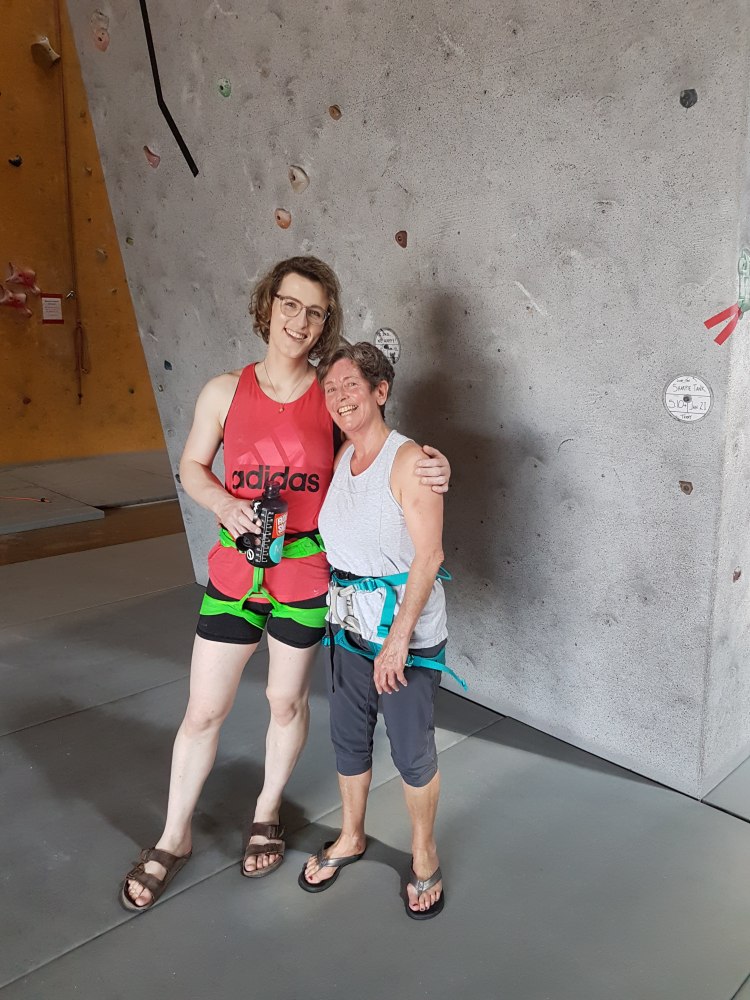
The Old Man in a Boat Tour would not have gotten off the ground without the support and encouragement of my wife June, and daughter Maya. They have helped keep my feet on the ground with timely advice and suggestions throughout this project.  June has put up with my absences while building the boat with wonderful good grace even as it meant a lot of extra work in the garden for her. Maya is my go to for all things technical.

Here they are after a pre-Covid climbing session at a local climbing gym in Hamilton.

I am blessed to have a wonderful family and both my sisters have been very supportive with insights and donations.  Leslie and Kathie live in Ottawa and Kelowna respectively and I haven’t seen them now for far too long.  As soon as I get this little adventure under my belt, and when it is Covid-safe to do so, I will be visiting them.  

Early on in the planning stages I made the decision to not have or seek corporate sponsorship.  It’s an expensive choice, since it means I have to finance all of the costs of the build and the tour, but I wanted to keep the focus entirely on the World Wildlife Fund. All donations are made directly to them and are then matched by an additional donation from my own funds, also directly to the World Wildlife Fund.

However, here is a short list of the suppliers of tools, boat parts, boat building materials, and hardware that I have found especially helpful:

Composites Canada -Mississauga 

Fogh Marine -Etobicoke

Noah’s Marine – Mississauga

Aircraft Spruce – Brantford

Brewer’s Marine – Hamilton

Lee Valley Tools – Burlington

Sportech Sails – St. Catharines

Also, my thanks to Laura at the Blue Water Motel in Grand Bend and Ann at the Parker House Hotel in Clinton for providing accommodation, often with only last minute notice.

The staff at the World Wildlife fund have been very helpful and supportive and have promoted my fundraiser with their members. 

I also should mention the members of the two sailing clubs I belong to – Hamilton Bay Sailing Club and Water Rat Sailing Club (Toronto) – who have shown a lot of enthusiasm and support for the project.  

Finally, as of today (July 24) we are over the $5,900 mark and I owe a huge vote of thanks to all 28 supporters who have donated to this fundraiser so far.

The continued adventures of Sandy…

The latest updates on the building of the Greta T (as of July 12):

My apologies for the dearth of updates but I have had my head down and have been working hard (with Skip Izon, the builder and designer) to get the boat finished and ready for the journey. Now that the restrictions are being eased we are working 5 days a week from 8 – 4 with 20 minutes for lunch and a 15 minutes break in the afternoons.
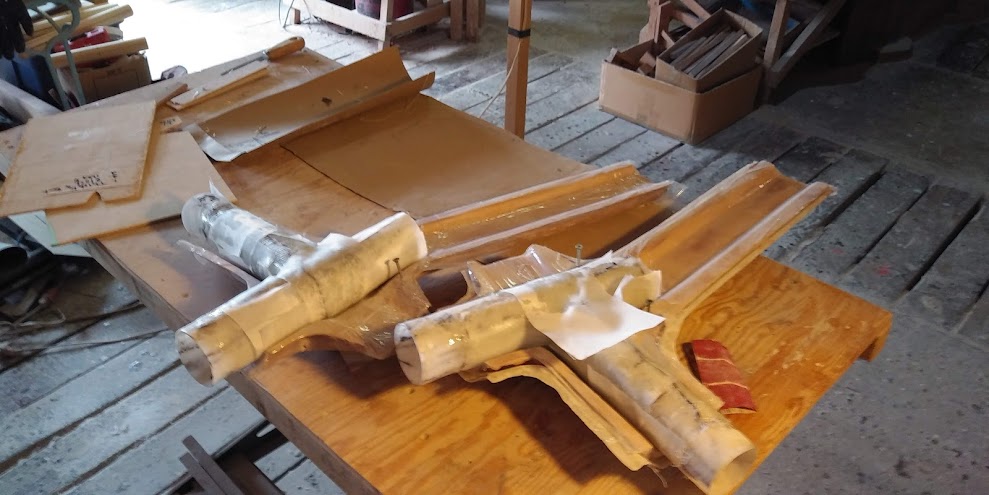
I am thinking of changing my middle name to “Sandy” as that has been a dominant feature of the work – sanding and fairing the rudder and centreboard and fabricating the mast and boom holders (the unusually shaped piece that allows the masts to rotate and tilt at the same time).

In the pictures below you can see how I first made the holders in rigid foam (insulation material) as one piece that separates into two halves. The second picture shows them taped off for fibreglassing. This will be removed from the form/mold and the foam on the inside shaped to make another fibreglass part that will take the mast and boom. These will then be further shaped and sanded and faired before joining the two parts into one unit that will be coated with multiple layers of special carbon fibre cloth for stiffness to resist the forces on the mast and boom from sailing. The colour scheme is a result of the rolls of electrical tape that I had – pretty jazzy, eh? The shiny tape allows the fibreglass to be removed from the form easily, but just to be sure I waxed and buffed it as well.

The small “bulge” at the front is to provide an internal cross-sectional strengthening piece to stiffen the boom (holds the sail at the bottom edge). On conventional sail rigs, there is a pivoting piece called a “gooseneck” that holds the boom to the mast and some rope/pulley arrangement called a “boom vang” to hold it down and help shape the sail. The Greta T is a very different boat in that there is no room for this – the mast and boom form a rigid (almost 90 degree) angle.
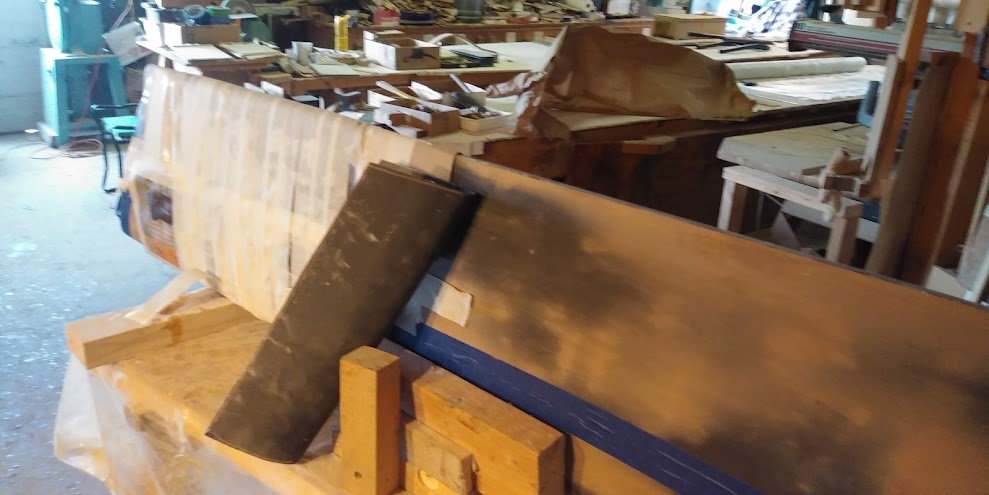
It is these many small details which are “different” to your average boat that make the Greta T unique, but are time consuming to figure out and build. Since this is likely the only/last boat that I will ever build I have decided that nothing ventured, nothing gained will be our motto. Skip and I are fairly sure the design is fast, that the boat will be robust and safe, and that the decidedly different systems for rowing and holding the mast and sails will all work as intended. We have a backup plan (a slightly more conventional system for the masts and sails) but I really hope we don’t have to use it!

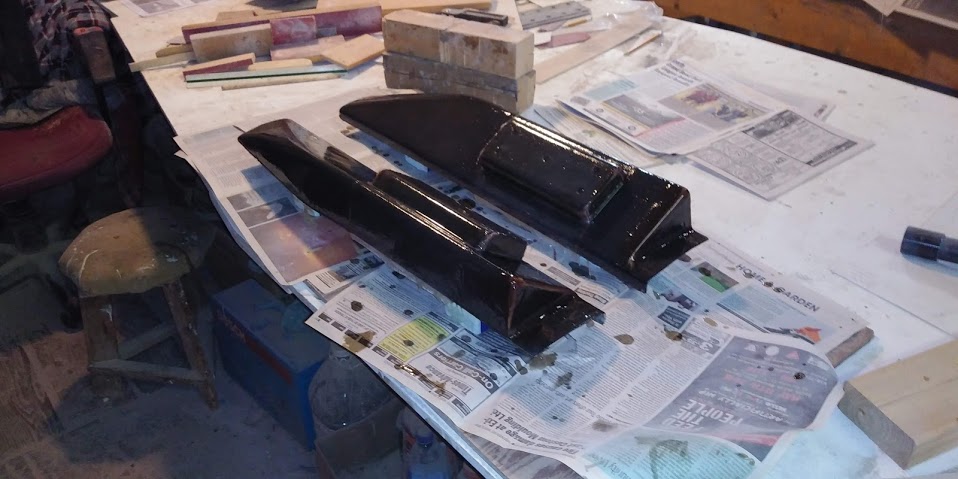
The oar holders are another part that has taken a lot of time and thinking/problem-solving. Basically we needed a unit that would hold the EZ row units at the right height and angle to the water and withstand the stresses that the rowing motion generates but still allow the oar units to be detached for sailing. We came up with a two part system (a box that is bolted to the rowing unit and then drops on top of the “adapter shape” that is attached to the boat. Skip built and shaped pink foam into this shape then fibreglassed and added carbon fibre to it. The system of bolts to attach it to the hull required carefully fitted blocks inside, each shaped to the curve of the hull.

Here you can see the two shapes – the long narrow parts will face forward and are shaped to cut the water cleanly if the boat is heeled while sailing. The raised “pad” on the top is to snugly hold the box part which is bolted to the EZ row unit. Two rope straps with a purchase system of small pulleys will hold it all in place. The idea is that I will row if the wind is light and then as it increases, detach the oar unit and stow it in the stern in specially shaped holders. The black (for now, as it will be painted grey to match the hull colour) “receiver” shape gets left on for sailing.

I realize as I re-read this post that it is a bit technical and perhaps more of interest to those who are really into sailing and boat-building. So here’s something a bit more personal, while still part of our building process.

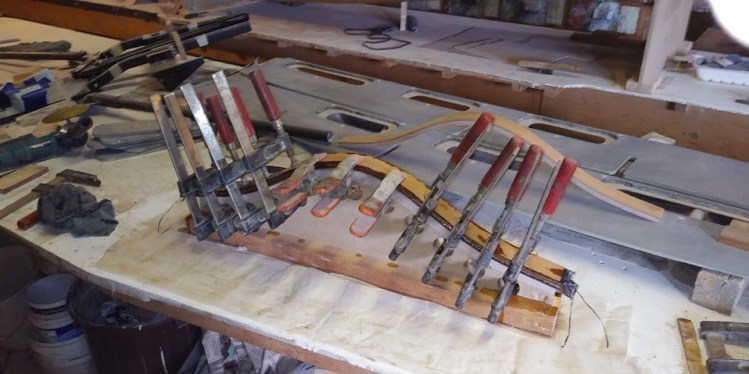
We needed two laminated curved wood pieces (one for the stern to support the rudder post and fittings and the other to stiffen the mid-ship bulkhead which supports the main mast). We made these from 5 thin (1/8”) slats epoxied in layers (with two carbon fibre layers) and clamped on a curved form. The curve mimics the curve of the fore deck and is derived from a mathematical curve called the “bell” curve or normal distribution – a shape that my mathematical self finds highly pleasing.

The top layer we made from some 60 year old mahogany bequeathed to me by my father, Jack Robertson, who was a skilled amateur woodworker; it was an off-cut from a built-in wardrobe he made for our family home in Hamilton. I have included the picture of the lamination in the clamps and one of the two finished pieces. So I will be traveling with a nice little memory of my Dad and our home on Concession Street with me! As the offspring of a pack-rat I obviously inherited the gene.

Rowing made EZ

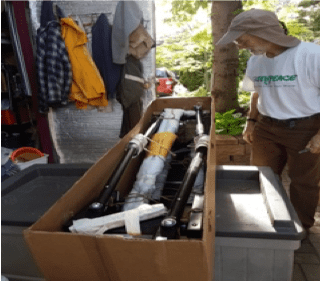
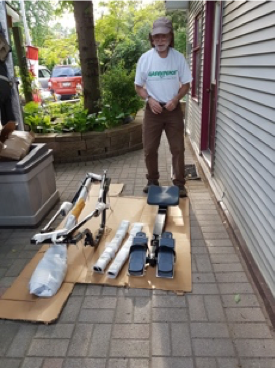
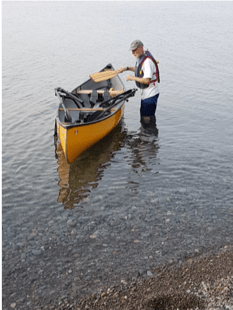
A few years ago, when I was planning the “Old Man in a Boat Tour” as trip on European waterways, I went down to the US to test out the EZ Row system.  I particularly wanted a forward rowing system since I can’t turn my head very well due to a neck injury and I sort of like the idea of seeing where I am going rather than where I have been!  The designer/inventor and builder (Ed Nemeth) is an old guy like me and I got to try it out rigged up on his canoe (the day after he had just completed a 72-mile race!).  I was sold – it is well machined and well thought out.  I ordered one, which fortunately took only about 3 weeks to come (at the time Trump was throwing tariffs on all things Canadian and I was afraid I would get caught in some sort of border/customs dispute).

It came in a big box and there were lots of parts:

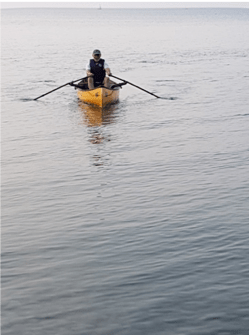
        But I finally got it ready to test out (in my canoe). And rowed off into the sunset!  After two years of practicing with it on the canoe, all that remains now is to adapt it to the shape of a new boat (the Greta T).

What about safety?

What about safety?  This is such a necessary part of any planned trip on the water I want to reassure anyone who is following this tour or supporting it, that I take safety seriously and will be thoroughly prepared before I set out. I want the Old Man in a Boat Tour to be remembered for all the right reasons!

The Old Man in a Boat Tour is a long trip- solo and for the most part unsupported – so how am I going to stay safe – sailing, rowing, camping and from Covid?  This calls for no small amount of advance planning and indeed, the Greta T has been built with safety features as well.  So let’s get down to the nitty-gritty of my safety plans.

  1.  The Boat:  the Greta T hull is wood (with a bit of carbon fibre skinned foam core panels for the bulkheads and floor) so all of this floats. There are also sealed buoyancy chambers under the floor, along part of the side decks and under the foredeck at the bow for further safety.  The mast sections will be sealed and the sails have been designed with a built-in floating foam pad at the head of each sail to help prevent inversion (turtling… in sailor parlance) in the event of capsize.  Speaking of capsizing, yes it does happen even to experienced sailors, so part of the work up and testing will include a capsize drill.  However, we have designed the Greta T to be self-bailing:  the floor slopes to the stern which is substantially open so all water will drain out pretty quickly.  A short “shake-down cruise” is planned to 50 Point Park.
  1. Skip Izon and I have planned for a sail rig that can be “reefed” (reducing the sail area) in the event of strong winds.  The masts can be rotated to roll the sails up and the battens (the sticks in the sail to support its shape) are quite long and on the diagonal, but made to be flexible enough to roll up with the sail as well.  If it’s really windy, my plan is to move the foresail (smaller) back to a second mast position further aft and sail with that alone, leaving the mainsail completely reefed or even taken down and stowed in the boat.  One of my Laser sailing friends thought I had elected to have a pretty substantial sail area (mainsail: 56 sq. ft.; foresail: 38 sq. ft.) – for comparison, a Laser (one sail – cat rig) full-rig is 72 sq. ft. – but I feel confident that the sails are mounted so much closer to the deck than in most small dinghies and that this will be a big factor in helping the Greta T keep on her feet (with some hiking from her skipper, too).  Reefing the sails (one or both) will also help keep the boat well balanced.
  1. Safety equipment:  as well as the usual, required gear (throwing rope, bailer, whistle, pump, life jacket) I am going to have a small set of navigation lights for emergencies, a really good flashlight,  an anchor and line, waterproof charts and a GPS, a phone in a waterproof pouch, a solar charging device, some binoculars and my trusty compass from my Laser.  I am also taking some strategically selected small spare parts and an emergency patching kit.  A couple of small, hand held flares are being contemplated as well.  
  1. Amongst my camping gear I am going to have a small stove, an emergency warming blanket and a small first aid kit.  Although I am traveling pretty lightly, I will have adequate clothing and protection for sun and rain – it’s a given that when sailing on a small boat like this one will get wet!  At the Laser Masters’ regattas I am always being teased for wearing two “Buffs”, a floppy hat and sunglasses – you can’t tell who’s sailing the boat!
  1. I am also retro-fitting (courtesy of Maya) my life jacket with a new belt/buckle and two stainless steel “D” rings to attach a tether device with two leads so I can move about the boat and always stay attached.  Skip primarily builds showroom boats (lovely matched grain and shining varnish).  It was a bit of a battle of wills to get him to allow fittings on the deck and re-entry safety lines, but they will be there!  Although the pictures we have posted of the build show a wood exterior, the hull will be painted with only the fore deck as naturally finished wood (I have the blisters from all the sanding and leveling to show for it!).
  1. I will be filing a “float plan” each day after a weather check with my team (June and Maya on the home-front) and we will have a nightly call in procedure.  
  1. I must admit that I am somewhat concerned about visibility and speeding motorboats – especially on the TSW (Trent Severn Waterway).  With the sails rolled up and rowing the boat, the boat’s profile in the water is quite low.  The forward rowing system is great from this respect as you can see where you are going, but I wanted something to increase the visibility of the boat (other than painting it fire-engine red!).  I found these neat highly reflecting, almost holographic, stickers that can be put on both sides of the blades of the oars – they flash quite brightly with the motion of rowing, even on a fairly cloudy day!  I am still going to keep my whistle close at hand!  The Greta T has a beam of 40”, so even if I take on a bit of water from someone’s wake, I think I will be pretty stable.  
  1. Covid preparations:  I have been vaccinated – once – and was hoping to squeeze the booster in before setting out.  My second dose appointment was initially scheduled for late August but it remains to be seen how much provincial timelines are advanced in the coming weeks.  So I will be taking a good supply of washable masks (custom made by Maya), hand cleanser and will be practicing strict social distancing everywhere I go and minimizing my land traveling to grocery supply/restocking trips only.  The sight-seeing is all from the water anyway!
  1. Finally, what about me… am I prepared for this sort of trip?  Well, I hope you will count the training I have been doing to get into shape for what potentially could be a full day or days of rowing (please pray for wind, but not too much ☺) – rowing 4 – 5 km. a day, a nice long walk with June each day and 30 minutes of pretty strenuous calisthenics*.   Although I have a RYA Coastal skipper certificate from my days in the Royal Navy, I decided I might be just a bit rusty so I have been doing a lot of reading and on-line work with charts and navigation.  If you read a blog post from me in Montreal, you’ll know I missed the left turn at Trenton…

I hope this detailing of my plans and activities regarding making this a safe trip has been informative and reassuring, but if you have any concerns/questions or suggestions please get back to me through the comment feature on the web-site.

  • An excellent guide to exercise for body and mind health is “Seven Minutes of Magic“ by Lee Holden.  Avery/Penguin.  New York. 2007